Healthcare Staffing Trends in 2025: What’s Reshaping the Workforce


Healthcare staffing in 2025 looks very different than it did just a few years ago. Between persistent workforce shortages, rising labor costs, and new digital solutions, organizations are rethinking how they deploy nurses and other clinical professionals. Two models, shift-based staffing (like per diem assignments) and travel nursing, remain at the center of most strategies, yet both are evolving rapidly as technology, worker preferences, and operational pressures shift.
Below is a restructured look at the major forces shaping the staffing landscape today, how shift staffing compares to travel nurse staffing, and the role platforms like Vars Health play in helping organizations manage new challenges.
Why Healthcare Staffing Is Changing So Quickly
Healthcare facilities continue to face fluctuating patient volumes and unpredictable labor shortages. At the same time:
Nurses are demanding more control over their schedules
Facilities are searching for cost-stable staffing options
Agencies are adopting automation to keep up with compliance demands
Technology is making real-time workforce management possible
These shifts have pushed organizations to lean more heavily on both contingent and travel staff, but the way these workers are sourced, paid, and integrated is transforming.
Shift Staffing: The New Normal for Daily Flexibility
Instead of relying exclusively on full-time staff, many health systems are building agile workforce models based on short-term assignments. Here’s what’s influencing this change:
Digital, On-Demand Shift Marketplaces
Apps that instantly match local clinicians with open shifts have become standard. Nearly all healthcare executives report using or reviewing these tools to speed up staffing decisions. With real-time posting and immediate clinician selection, facilities can avoid last-minute schedule gaps and reduce time spent on administrative coordination.
Increasing Push for Work-Life Control
Nurses are gravitating toward per diem and temporary shifts because these roles offer autonomy and help limit burnout. Longer shifts, especially those stretching beyond 12.5 hours, are linked to higher error rates, making flexible scheduling more than just a perk; it’s a safety strategy.
Leveraging Local Nurses for Cost Stability
Health systems are embracing regional talent pools and internal float pools. Doing so minimizes housing and travel expenses, and because local clinicians already know facility processes, continuity of care improves.
Automated Credentialing and Compliance
Modern credentialing tools eliminate delays that once slowed last-minute staffing. Automated license checks and compliance alerts allow facilities to fill urgent openings without sacrificing regulatory accuracy.
Mitigating Burnout Through Smarter Staffing
Burnout remains a top contributor to turnover. Facilities that intentionally use contingent staff to distribute workloads more evenly have seen reductions in overtime and improvements in retention.
Travel Nurse Staffing: A Model That’s Stabilizing, Not Disappearing
While shift staffing dominates local needs, travel nursing maintains a vital role, especially in high-acuity or hard-to-staff departments.
A Market Reset After Historic Peaks
During COVID-19, travel nursing exploded, growing more than 400% from 2018 to 2022. The market has since corrected, with revenues falling about 30% by 2024 as hospitals returned to permanent hiring. Even so, the demand for specialized travel nurses remains strong, with modest growth projected through 2025.
Attractive Pay Packages Continue to Influence Movement
Travel nurses still earn significantly above average salaries, sometimes between $90,000 and $100,000 annually, plus stipends and bonuses. These costs, however, pose financial challenges for hospitals relying heavily on travelers year-round.
Telehealth Expands the Definition of Travel Nursing
A growing number of travel-based roles no longer require physical relocation. Remote nurses can support telehealth programs from any location, creating new staffing avenues for both clinicians and facilities.
Specialty Experience in High Demand
Roles in mental health, chronic care, geriatrics, and cultural competence are becoming increasingly important. Hospitals facing long-term shortages in specialty units rely on travel nurses to maintain service levels.
Integration Remains a Concern
Short assignment lengths can make it difficult for travelers to fully integrate into hospital teams. At peak pandemic demand, travel nurses represented nearly 40% of labor spend for some systems, a major financial strain. Many executives are still seeking sustainable alternatives.
Comparing Shift Staffing and Travel Nursing
To understand when each model works best, it helps to examine their core differences:
Category | Shift Staffing | Travel Nursing |
Assignment Length | Daily/weekly needs | 8–26 weeks |
Cost Structure | Low cost; no stipends | High cost; premiums + housing |
Workforce Preference | Great for flexibility | Appeals to those seeking stability & higher pay |
Team Integration | Strong; local staff know the facility | More difficult due to limited tenure |
Use of Technology | Highly dependent on real-time platforms | Increasingly supported by automation and telehealth tools |
Both models serve critical purposes, but neither alone is enough to meet today's staffing challenges.
How Technology, Including Vars Health, Is Transforming Staffing
Regardless of the staffing approach, one trend stands above the rest: Technology is the backbone of modern workforce management.
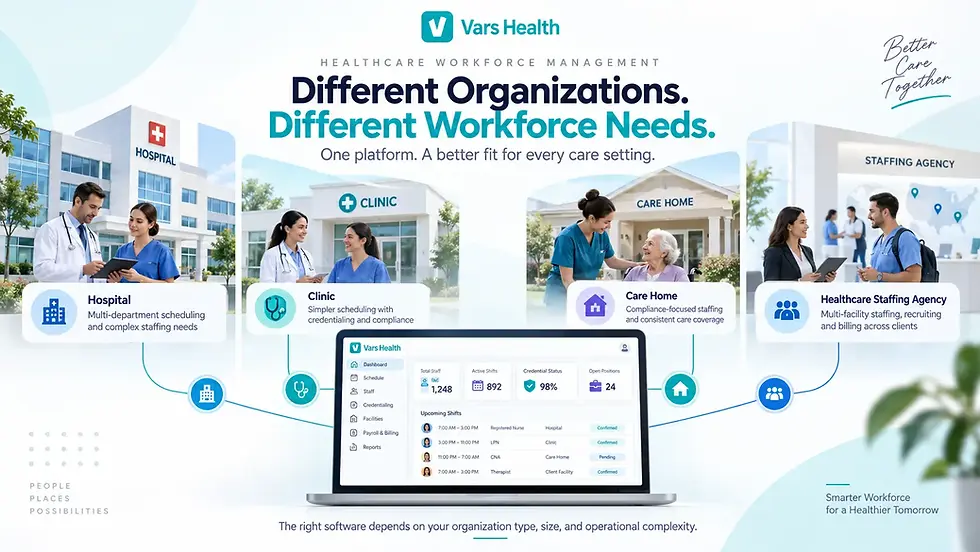
Platforms like Vars Health support agencies and facilities by providing tools such as:
Real-time talent matching
Automated pay and stipend calculations
Credential and compliance verification
Configurable rules for overtime and pay types
Integrated communication and shift management
These features reduce administrative time, strengthen compliance, and help organizations maintain profitability while filling staffing gaps more efficiently.
Looking Ahead: What Healthcare Staffing Will Look Like Beyond 2025
The healthcare sector will continue to depend heavily on contingent labor due to:
An aging population
Persistent clinical shortages
Greater workforce demands for flexibility
Shift staffing will remain a cost-effective option for day-to-day operations, while travel nursing will continue to support specialized areas and underserved locations. Healthcare organizations that invest in strong technological infrastructure will be the ones best positioned to balance cost, quality, and caregiver satisfaction.
Platforms like Vars Health will play an increasingly important role in helping agencies streamline operations, enhance reliability, and deliver scalable workforce solutions.