Is Healthcare Staffing Software the Answer to Temporary Staffing Challenges?

Updated: Nov 11, 2025

In today’s high-stakes healthcare environment, one of the most pressing issues facing hospitals and health systems is the rising cost and complexity of filling short-term roles. As temporary staffing demands surge, leaders are asking whether healthcare staffing software is more than just a nice-to-have; it might be the solution to temporary staffing challenges healthcare systems face. Traditional agency-based models struggle with high mark-ups, slower starts, and fragmented workflows. By contrast, a comprehensive healthcare staffing software solution enables better per-diem management, empowers internal resource pools, and supports a healthcare staffing automation platform mindset. In short: yes, strategic adoption of technology could be the turning point in how organisations manage, engage, and schedule talent in a world of ongoing staffing volatility.
Healthcare Staffing Software: Implausible or Imperative?
Let’s be honest, healthcare organizations today are walking a financial tightrope. Rising labor expenses, fluctuating patient demand, and post-pandemic staffing shortages are pushing hospitals and health systems to rethink every aspect of their operations. Among all these challenges, one area stands out as both critical and costly: temporary staffing.
For years, healthcare facilities have relied heavily on agency-based temporary workers, especially travel nurses, to fill urgent staffing gaps. While this model once served its purpose, it’s no longer financially sustainable or operationally efficient in today’s volatile environment. Cutting agency costs alone isn’t enough; the real solution lies in adopting healthcare staffing software that empowers hospitals to take back control.
By leveraging a comprehensive healthcare staffing software solution, providers can:
Reduce dependency on third-party agencies by optimizing internal float pools and per-diem staff.
Automate scheduling and compliance workflows to minimize administrative burden.
Gain real-time visibility into staffing data to make smarter, faster decisions.
Enhance workforce flexibility through a scalable healthcare staffing automation platform that adapts to both short-term and long-term needs.
In short, healthcare staffing software isn’t just a modern convenience; it’s becoming an operational necessity. For providers striving to balance patient care quality with financial stability, investing in intelligent staffing technology is not just plausible; it’s imperative.
The Rise of Temporary Staffing, and Its Ripple Effects
The past few years have completely transformed how the healthcare industry approaches staffing. During the COVID-19 pandemic, the temporary healthcare staffing sector witnessed explosive growth unlike anything seen before. News headlines showcased stories of travel nurses earning more in six months than full-time nurses made in a year, while staffing agencies rapidly expanded to meet nationwide demand. This surge not only filled urgent clinical gaps but also reshaped how healthcare professionals viewed their careers.
As the pandemic spotlighted the flexibility and high pay associated with travel contracts, it essentially became free advertising for the temporary staffing model. Thousands of nurses began to realize the earning potential and autonomy that came with short-term or per-diem roles, fueling a major shift in the healthcare labor landscape.
Big Numbers, Bigger Implications
The scale of this shift is staggering. According to early 2023 reports, hospitals with the highest temporary staffing spend dedicated an average of 2.23% of their total operating budgets to this expense. That might sound small, but in reality, it translates to an average of $465 million per year, with some large systems spending over $3 billion annually just on temporary staff.
These numbers make one thing clear: temporary staffing isn’t merely a budget line item; it’s a structural challenge with long-term consequences. For many hospitals, nurses, long considered the heart of patient care, have also become a major source of financial strain. The question now isn’t whether to use temporary staff, but how to manage the growing costs and dependencies that come with them.
Shifting Perceptions Among Nurses
Before the pandemic, most full-time nurses viewed travel or per-diem roles with caution, admiring the pay but hesitant about the instability and sacrifices involved. Today, that perception has completely changed.
Ask a nurse now, and you’ll often hear something like:
“They make double what I do each week, take months off, and still match my yearly salary. I’d switch if I could.”
This isn’t just a passing trend; it’s a cultural shift in the nursing profession. Travel nursing and flexible staffing models have become an aspirational career path, one that prioritizes autonomy, compensation, and lifestyle balance.
For healthcare employers, this changing mindset demands new strategies. The answer lies in healthcare staffing software solutions that help organizations stay competitive by managing temporary staffing challenges in healthcare more efficiently, offering flexible scheduling, smarter resource allocation, and fairer compensation models that align with the expectations of today’s nursing workforce.
In this new era, healthcare staffing automation platforms like Vars Health aren’t just tools; they’re the bridge between workforce satisfaction and organizational sustainability.
The Real Question for Providers: Value vs. Viability
The healthcare staffing landscape has changed, and nurses are at the center of this transformation. Many are beginning to ask tough, honest questions shaped by what they see across the staffing marketplace:
“If hospitals can pay travel nurses twice as much, why aren’t we valued the same way?”
This question goes beyond pay; it highlights the core issue driving the temporary staffing challenges in healthcare today. What is the true value of a nurse, and how can healthcare systems recognize that value while staying financially viable?
For decades, hospitals operated under a local talent competition model, recruiting within their region and offering incremental raises to retain full-time staff. But that model no longer works. Today’s nurses live in a digital-first, flexible work era shaped by the gig economy. They can pick up shifts across states, choose per-diem or contract work, and leverage mobile platforms to find the best opportunities.
This new reality has made it clear: hospitals aren’t just competing with other hospitals anymore. They’re competing with flexibility, lifestyle, and freedom. To remain competitive, providers must rethink their workforce strategies, not just by increasing pay but by creating systems that deliver autonomy, transparency, and balance.
That’s where healthcare staffing software solutions come in. A modern healthcare staffing automation platform gives hospitals the tools to:
Offer more flexible scheduling options to meet staff preferences.
Streamline per-diem and internal float pool management.
Enhance engagement and retention by aligning assignments with nurses’ goals.
Reduce dependency on external travel agencies while maintaining coverage.
Ultimately, the real question isn’t just about cost, it’s about value. And with the right healthcare staffing software, hospitals can finally bridge that gap: valuing their nurses while ensuring the long-term financial sustainability of care delivery.
Enter Healthcare Staffing Software: The New Strategic Driver
In today’s fast-changing healthcare environment, providers need more than cost-cutting; they need strategic transformation. This is where healthcare staffing software becomes not just helpful, but essential. By adopting a technology-first approach, hospitals and health systems can move away from over-reliance on expensive external agencies and regain control over workforce operations, costs, and outcomes.
Modern healthcare staffing software solutions empower organizations to create smarter, data-driven staffing models that align financial goals with staff satisfaction and patient care quality. Here’s how it drives meaningful change:
1. Build Internal Resource Pools
Instead of depending on third-party staffing agencies, healthcare organizations can create internal pools of qualified nurses and clinicians, both full-time and per-diem. These internal teams can be dynamically redeployed based on real-time patient demand.
Healthcare staffing software automates shift coordination, eliminating manual errors and last-minute chaos.
Facilities gain visibility into staff availability across departments and locations.
The result: higher coverage rates and reduced overtime or agency dependency.
2. Optimize Scheduling & Forecasting
Predictive analytics and intelligent algorithms help providers anticipate patient volume trends and plan staffing accordingly.
Automated forecasting reduces last-minute scheduling gaps.
Balanced shift assignments prevent staff fatigue and burnout.
Managers gain instant insight into workforce utilization and cost impact. This proactive approach ensures that the right clinician is in the right place at the right time, every time.
3. Improve Staff Engagement
A modern healthcare staffing automation platform goes beyond scheduling; it enhances the entire employee experience.
Transparent schedules give staff clarity and control.
Self-service shift swaps and mobile-friendly apps empower nurses to manage their own schedules.
Real-time communication tools help keep everyone connected and informed. When clinicians feel valued and supported, retention improves, reducing turnover costs and boosting long-term workforce stability.
4. Reduce Reliance on Agencies
A robust healthcare staffing software solution helps healthcare providers cut down on costly agency contracts without compromising care quality.
Facilities can directly engage their internal and per-diem talent.
Shifts get filled faster with less administrative overhead.
Markup and vendor management fees shrink significantly.
By centralizing workforce management through healthcare staffing software, providers regain control of staffing costs, improve operational efficiency, and strengthen their employer brand, all while delivering consistent, high-quality patient care.
In short, healthcare staffing software isn’t just a tool for cost management, it’s a catalyst for transformation. For hospitals navigating ongoing labor challenges, adopting this technology is the key to achieving sustainability, flexibility, and resilience in the modern healthcare landscape.
Why the Status Quo Won’t Work Anymore
It’s tempting to believe that staffing costs will eventually fall back to pre-pandemic levels, but that’s no longer realistic. The healthcare staffing market has evolved, and so have the people who keep it running. Nurses today have new expectations shaped by their pandemic-era experiences: flexibility, autonomy, and fair compensation are no longer perks, they’re baseline requirements.
Healthcare providers who continue relying on outdated staffing models risk repeating the same costly mistakes:
Chronic staffing shortages lead to burnout and high turnover.
Escalating budgets driven by agency markups and overtime pay.
Low morale among staff who feel undervalued and overworked.
Simply put, doing more of the same won’t lead to different results. It’s time for healthcare leaders to embrace innovation instead of waiting for old systems to “reset.”
This is where healthcare staffing software becomes transformative. Just as technology has revolutionized logistics, finance, and customer service, it’s now reshaping how hospitals manage their workforce. Through automation, predictive analytics, and mobile-first design, a healthcare staffing software solution helps organizations create agile, efficient staffing systems that prioritize both operational control and employee satisfaction.
In today’s reality, clinging to traditional methods is no longer sustainable, but adopting the right healthcare staffing automation platform can redefine how hospitals attract, schedule, and retain top clinical talent for the long term.
The Vars Health Advantage
At Vars Health, we understand that today’s healthcare staffing challenges go far beyond filling shifts. They’re about balancing financial sustainability, workforce satisfaction, and quality patient care, all at once. That’s why our healthcare staffing software is designed not just as a scheduling tool, but as a complete, future-ready healthcare staffing software solution that empowers providers to take control of their workforce strategy.
By bringing together automation, intelligent scheduling, internal pool management, and real-time analytics, Vars Health enables hospitals and healthcare systems to make smarter, faster, and more cost-effective staffing decisions.
With Vars Health, you can:
Lower staffing costs through reduced agency reliance and optimized internal resource deployment.
Increase clinician satisfaction by offering transparency, flexibility, and easy self-scheduling options.
Improve patient outcomes by ensuring the right staff are always available when and where they’re needed.
Stay agile in a volatile labor market with an adaptable, data-driven healthcare staffing automation platform.
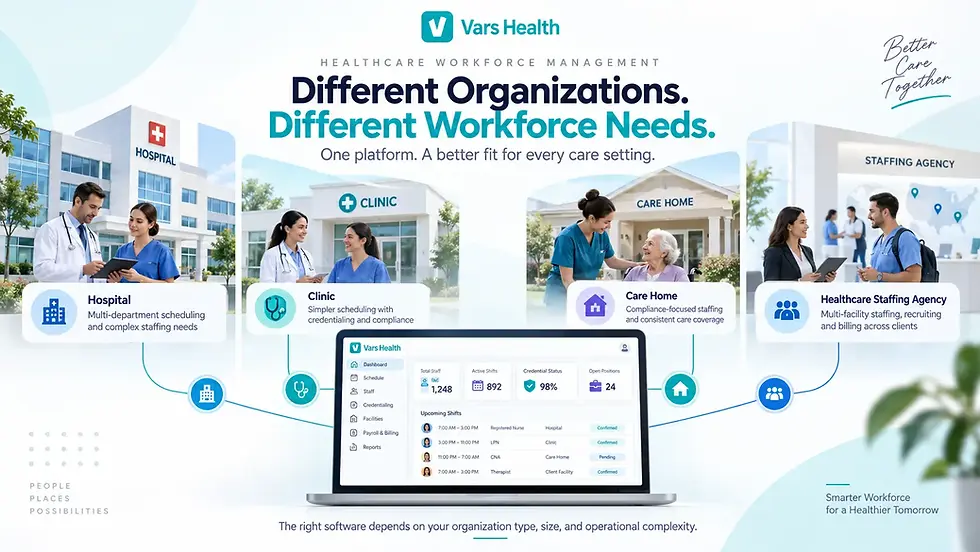
Whether you manage a large multi-facility network or a single hospital, Vars Health scales effortlessly to meet your operational needs. Our platform gives you the flexibility, foresight, and control required to thrive in today’s evolving healthcare landscape.
The future of staffing isn’t about working harder, it’s about working smarter. With Vars Health’s healthcare staffing software, providers can finally achieve a sustainable balance between workforce efficiency and compassionate care.
Looking Ahead: Technology is the Key
Every major shift in healthcare has been fueled by innovation, and staffing is no different. The reality is clear: healthcare staffing software is no longer a luxury; it’s a necessity. As workforce shortages persist and costs rise, technology has become the defining factor separating organizations that thrive from those that merely survive.
Hospitals and health systems that continue relying on outdated staffing models risk falling behind competitors that are faster, leaner, and more efficient. By embracing a healthcare staffing software solution, providers can automate manual workflows, optimize scheduling, and create a better experience for both clinicians and patients.
Technology is now the driving market force behind the transformation of healthcare staffing. The question isn’t “Should we adopt it?”, it’s “Can we afford not to?”
In a world where agility, transparency, and efficiency define success, a modern healthcare staffing automation platform like Vars Health empowers providers to stay ahead, building a resilient, cost-effective, and people-centered staffing ecosystem for the future of care.
Conclusion: From Implausible to Imperative
Not long ago, healthcare staffing software was seen as an optional upgrade, a nice enhancement for forward-thinking hospitals. Today, it has become an absolute necessity. The staffing crisis facing healthcare isn’t temporary; it’s structural. But the good news is that the solution is already here.
By embracing a healthcare staffing software solution, providers can reimagine how they manage their workforce, moving from reactive staffing to proactive, data-driven decision-making. Technology enables hospitals to reduce costs, streamline scheduling, and most importantly, create a more balanced and rewarding work environment for nurses and clinicians.
The path forward is clear:
Embrace the shift toward automation and smarter staffing practices.
Empower your staff with flexibility, transparency, and control.
Transform your outcomes through innovation, efficiency, and care quality.
At Vars Health, we’re redefining what’s possible in workforce management. Our healthcare staffing automation platform equips providers with the tools and insights needed to stay ahead in a competitive and ever-changing labor market.
The future of healthcare staffing isn’t implausible; it’s imperative. And with Vars Health, that future starts today.
FAQs
1. What is healthcare staffing software, and how does it work?
Healthcare staffing software is a digital platform that automates and streamlines the process of recruiting, scheduling, and managing clinical staff. It helps hospitals and healthcare organizations fill shifts faster, optimize internal float pools, and reduce dependency on third-party staffing agencies, all while improving staff satisfaction and operational efficiency.
2. How can healthcare staffing software help solve temporary staffing challenges in healthcare?
A healthcare staffing software solution helps providers manage fluctuating workforce needs by offering predictive scheduling, automated shift matching, and real-time visibility into staff availability. This reduces burnout, lowers costs, and ensures continuity of care, addressing the root causes of temporary staffing challenges in healthcare.
3. What are the main benefits of using a healthcare staffing automation platform?
A healthcare staffing automation platform provides numerous benefits, including:
Streamlined scheduling and compliance tracking.
Reduced agency fees through direct staff engagement.
Data-driven workforce insights for better forecasting.
Higher staff retention through transparency and flexibility. These tools help healthcare organizations stay agile in a rapidly changing labor market.
4. How does healthcare staffing software support per-diem and flexible staffing models?
Per-diem staffing software in healthcare enables hospitals to efficiently manage flexible staff who work on demand or part-time. It automates shift assignments, ensures fair scheduling, and provides mobile access for clinicians to choose shifts, promoting autonomy while keeping operations smooth and cost-efficient.
5. Why should healthcare providers adopt healthcare staffing software now?
The post-pandemic labor market has permanently changed. Nurses expect flexibility, fair pay, and modern tools to manage their schedules. Without healthcare staffing software, providers risk falling behind competitors who are faster, more efficient, and better at retaining talent. Adopting technology like Vars Health’s healthcare staffing automation platform is no longer optional, it’s essential for long-term sustainability and success.