
Top Placement Agency Software in the USA for Recruiters
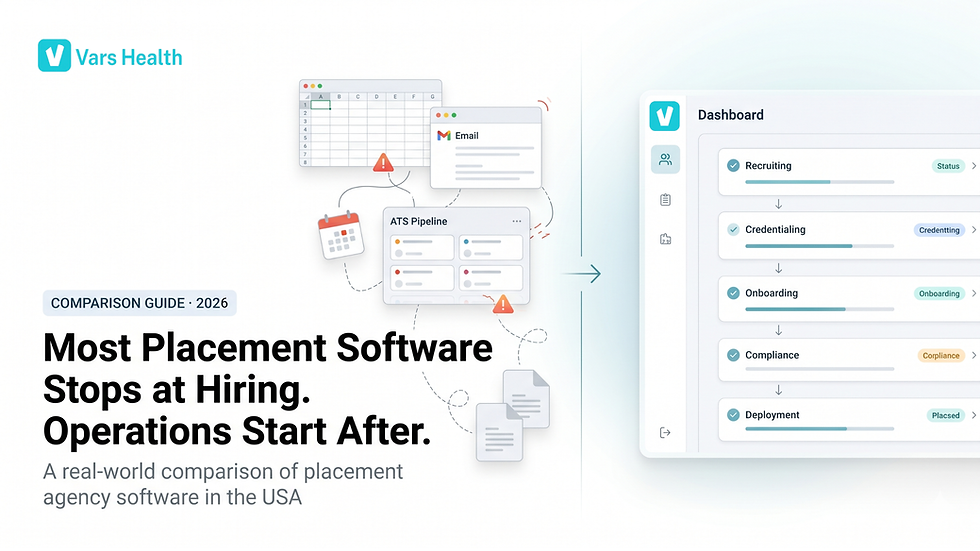
If you've searched for placement agency software, you already know the market is crowded. ATS platforms, CRM hybrids, credentialing add-ons, payroll connectors, the options multiply every year, and so does the confusion about which category actually solves your problem.
Here's the short answer: placement agency software is any platform that manages the end-to-end workflow of matching candidates to client job orders from sourcing and recruiting through credentialing, onboarding, deployment, and billing. But "end-to-end" is where most vendor marketing diverges from what products actually do.
Most tools on the market are ATS-first. They're excellent at tracking applicants through a pipeline, but an applicant tracking system alone rarely covers the compliance and onboarding depth healthcare staffing requires. What they struggle with is everything that happens after a candidate says yes: the compliance documentation, the onboarding packets, the shift scheduling, the real-time visibility that operations leads need. That gap is where agencies bleed time, money, and talent.
This guide walks through the real operational tradeoffs, not just feature checklists so agency owners and operations leaders can make a more grounded decision.
WHAT THIS GUIDE COVERS We evaluate seven platforms: Vars Health, Bullhorn, Avionté, CEIPAL, JobDiva, Zoho Recruit, and Enginehire. Each review covers genuine strengths, real limitations, and the agency profile each tool fits best. |
1. What is placement agency software, and how is it used in real staffing operations?
The term "placement agency software" describes a category of tools broad enough to include everything from a basic resume database to a full operations platform managing scheduling, compliance, and billing. That breadth is part of the problem.
When most vendors market their product as placement software, they're describing the recruiting layer: job requisition intake, candidate sourcing, pipeline management, and interview tracking. For agencies doing light-touch permanent placement, that's often enough. For healthcare and allied health staffing agencies where every placed candidate requires credentialing verification, licensing checks, onboarding documentation, and compliance tracking, an ATS alone is structurally insufficient.
The full staffing workflow (and where software usually stops)
Sourcing → Recruiting → Credentialing → Onboarding → Deployment → Payroll & Billing
Most ATS platforms handle the first two steps reliably. A smaller number extend meaningfully into credentialing and onboarding and fewer still provide genuine depth across all six phases. When they don't, agencies fill the gaps with spreadsheets, email chains, shared drives, and manual follow-up.
“We had Bullhorn for the ATS, a separate credentialing tracker in Google Sheets, a third tool for scheduling, and someone manually copying data between all three. Every new contract hire was a project.” — Operations manager at a 120-person travel nursing agency
That’s not an edge case. In most mid-size healthcare staffing agencies, the tech stack looks exactly like that, and the cost is measured in delayed start dates, compliance violations, and recruiter burnout.
COMMON OPERATIONAL MISTAKE Buying an ATS and calling it a staffing platform. An ATS optimizes the top of the funnel. But in healthcare staffing, the highest-risk (and most time-consuming) work happens after the offer is made in onboarding, credentialing, and compliance. Agencies that conflate these categories often discover the gap when it's already costing them start dates. |
2. How to choose the right placement agency software for your agency
Before evaluating any specific platform, it helps to be clear about which parts of your workflow are actually broken. Most agencies have two or three acute pain points and not every pain point requires the same solution.
Key evaluation criteria
Workflow coverage: Does the platform support your workflow end-to-end, or only specific phases?
Compliance depth: Can it track licensing, certifications, and document expiration dates with automated alerts?
Onboarding functionality: Can candidates complete onboarding digitally, including e-signatures and document upload?
Recruiter handoff: Is there a clear internal handoff from recruiter to onboarding/compliance team, or does it break down into email?
Payroll and billing integration: Does it connect to your payroll and billing systems, or does billing require manual extraction?
Scalability: Will the platform handle 3× your current volume without becoming brittle?
Implementation timeline: What’s the realistic go-live timeline and what does implementation support actually look like?
3. Top placement agency software in the USA for recruiters
Below is an honest evaluation of seven platforms commonly used by US staffing agencies. Each review is structured around who the tool is built for, what it does well, where it falls short, and which agency profile it fits.
1. Vars Health (Join Vars) OPERATIONS-FIRST PLATFORM Built for healthcare staffing agencies that need more than an ATS, covering the full workflow from recruiting through deployment readiness. |
Vars Health is positioned differently from most tools in this category. Where competitors start from an ATS foundation and layer on additional modules, Vars Health was designed around the operational reality of healthcare staffing with end-to-end workflows for recruiting, onboarding, credentialing, and deployment. In practice, this matters when an agency is managing travel nurses, per-diem allied health workers, or locum physicians populations where every candidate has licensing requirements, certification expiration dates, and facility-specific onboarding checklists. Managing that complexity in a spreadsheet or with disconnected tools is where agencies lose control of start dates. KEY STRENGTHS
LIMITATIONS TO BE AWARE OF
Best fit: Healthcare staffing agencies, travel nursing, allied health, locum tenens, and per-diem that have outgrown ATS-only tools and need genuine operational depth, especially around credentialing, compliance tracking, and deployment readiness. Particularly well-suited to agencies in a growth phase where manual processes are starting to break. |
2. Bullhorn ENTERPRISE ATS + CRM The market-leading ATS for large generalist staffing firms, with deep CRM capabilities and a broad integration ecosystem. |
Bullhorn is the dominant ATS/CRM platform for mid-to-large staffing agencies in the US. It's well-engineered for high-volume recruiting workflows, client relationship management, and job order tracking, and its ecosystem of integrations is genuinely extensive. For agencies that primarily do direct placement or light-touch contract staffing, Bullhorn covers a lot of ground. KEY STRENGTHS
LIMITATIONS TO BE AWARE OF
Best fit: Large, multi-vertical staffing agencies doing high-volume direct or contract placement with established operations teams and the bandwidth to manage multiple integrated tools. Less well-suited to healthcare agencies that need credentialing and compliance depth out of the box. |
3. Avionté ATS + PAYROLL PLATFORM A combined ATS and payroll platform that does well in light industrial and administrative staffing with a focus on compliance and workforce management. |
Avionté has built a strong reputation in light industrial, clerical, and administrative staffing verticals where weekly payroll runs, worker classification, and workforce compliance are central concerns. Its integrated payroll capability is a genuine differentiator compared to ATS-only tools, and it handles high worker volume reasonably well.
KEY STRENGTHS
LIMITATIONS TO BE AWARE OF
Best fit: Light industrial, administrative, and clerical staffing agencies that run large hourly workforces and need integrated payroll. Not a natural fit for healthcare agencies with complex credentialing requirements. |
4. CEIPAL AI-POWERED ATS An AI-augmented ATS with strong sourcing automation, built for IT and professional services staffing firms. |
CEIPAL has gained ground in IT staffing and professional services with an AI-driven sourcing and matching engine that reduces time spent on manual candidate search. It aggregates from multiple job boards, applies AI ranking to surface relevant profiles faster, and provides a clean interface for high-volume recruiting teams. KEY STRENGTHS
LIMITATIONS TO BE AWARE OF
Best fit: IT, professional services, and technology staffing firms prioritizing sourcing efficiency and cost-effective ATS functionality. Not suited to healthcare staffing that requires credentialing depth. |
5. JobDiva ENTERPRISE ATS + VMS INTEGRATION A powerful ATS with broad VMS connectivity and strong enterprise features, favored by large staffing firms operating in managed service programs. |
JobDiva has carved out a strong position in enterprise staffing, particularly for agencies operating within VMS (Vendor Management System) environments where connecting to client procurement platforms is essential. Its ATS is mature and handles large requisition volumes well. KEY STRENGTHS
LIMITATIONS TO BE AWARE OF
Best fit: Large staffing firms operating inside VMS-heavy enterprise programs (IT, finance, engineering) that need strong ATS and VMS connectivity. Not a good fit for healthcare-focused agencies. |
6. Zoho Recruit FLEXIBLE SMB ATS A cost-effective, customizable ATS well-suited to small and growing agencies that need a flexible starting point without enterprise pricing. |
Zoho Recruit is part of the broader Zoho ecosystem and benefits from competitive pricing, a reasonable feature set for its tier, and good integration with other Zoho products (CRM, Books, People). For small agencies doing primarily direct placement, it provides a solid foundation. KEY STRENGTHS
LIMITATIONS TO BE AWARE OF
Best fit: Small agencies (under 20 recruiters) doing direct placement in non-healthcare verticals, particularly those already using Zoho products. A reasonable entry-level choice — agencies at that inflection point often explore what a full staffing agency software stack actually needs to cover. |
7. Enginehire BOUTIQUE STAFFING PLATFORM A modern, modular platform designed for boutique and niche staffing agencies that need flexibility without enterprise complexity. |
Enginehire has positioned itself as a more modern alternative to legacy ATS tools with a cleaner interface, configurable workflows, and a growing feature set. It appeals to boutique agencies in niche verticals that find platforms like Bullhorn overpowered and too expensive for their needs. KEY STRENGTHS
LIMITATIONS TO BE AWARE OF
Best fit: Boutique and niche staffing agencies in non-healthcare verticals that want a modern platform without enterprise pricing or complexity. A reasonable choice for agencies outgrowing basic tools but not yet requiring deep compliance features. |
4. Why most placement agency software breaks down as agencies scale
There's a pattern that shows up consistently when working with healthcare staffing agencies in growth phases: the tools that got them to 50 placements a month stop working reliably at 150. Not because the platform is technically broken, but because the operational model that worked at a smaller scale creates systematic friction at a larger one.
The ATS-only trap
An agency buys a well-regarded ATS. Recruiters love it. Candidate pipelines are clean, job orders are tracked, and placements are logged. The distinction between an ATS and full staffing software only becomes visible after the offer is signed, when the problem emerges. The recruiter hands off a placed candidate to the onboarding team, and there's no structured workflow in the system for what happens next. The handoff happens over email. The onboarding team maintains its own spreadsheet. The compliance coordinator has a separate tracker for license expiration dates.
WHAT USUALLY BREAKS AT SCALE The recruiter-to-operations handoff. When this lives in email and institutional knowledge rather than a structured platform workflow, every new recruiter or coordinator who joins the team creates a new inconsistency. At low volume, teams compensate with effort. At high volume, it becomes a start-date problem and delayed start dates directly impact revenue and client trust. |
Compliance blind spots
In healthcare staffing compliance, a single expired license can prevent a clinician from starting or, worse, create liability if they've already started. Automated credential tracking is the operational fix that agencies most often defer to too long. Most ATS platforms do not natively track certification expiration dates with automated alerts. Agencies using ATS-only tools typically manage this in a separate spreadsheet that someone owns. When that person leaves, or when the spreadsheet grows past a manageable size, the system fails silently.
Disconnected payroll and billing
Payroll and billing in contract healthcare staffing are complex, multi-state taxes, blended rates, mileage and housing stipends, and weekly cycle reconciliation. When the ATS, the scheduling tool, and the payroll system are separate and don't communicate cleanly, the reconciliation burden falls on operations staff. At 50 active contractors, it's manageable. At 200, it becomes a full-time role dedicated to moving data between systems.
KEY TAKEAWAY FOR OPERATIONS LEADERS The right question when evaluating placement agency software isn’t “Does it have good recruiting features?” It’s “What happens after the offer? Where does the system end and the spreadsheet begin?” That boundary is where your operational risk lives. |
Where Vars Health is designed to close this gap
The operational problems described above, handoff gaps, compliance blind spots, and disconnected payroll data, are structural. They're not solved by adding another integration to an ATS. Vars Health approaches the problem differently: the workflow is built to persist from the recruiter’s initial engagement with a candidate all the way through deployment readiness and scheduling, with compliance tracking and onboarding visibility built into the same system rather than bolted on.
In practice, this means an operations lead can see in a single view which candidates are pending credentialing, which have outstanding onboarding documents, and which are ready to deploy. That visibility is what prevents the last-minute scramble that delays start dates and erodes client confidence.
5. Frequently Asked Questions
How long does it take to implement placement agency software?
Implementation timelines vary significantly. A lightweight ATS like Zoho Recruit can be set up in days. Mid-tier platforms like CEIPAL or Enginehire typically take 2–6 weeks. Enterprise platforms like Bullhorn or Avionté often require 2–4 months with professional services involvement, and that timeline extends further when custom integrations are required. The more complex your workflow (credentialing, compliance, payroll), the longer the implementation. Built-in training time: recruiter adoption is often the slower variable, not the technical setup.
What features matter most for healthcare staffing agencies?
For healthcare, the highest-value features extend beyond recruiting: credentialing and license tracking with automated expiration alerts, digital onboarding with document collection, compliance status visibility, and clear recruiter-to-operations handoff workflows. ATS capability matters, but it’s the post-placement functionality that determines whether agencies can maintain quality and speed as they scale. Scheduling and payroll integration are also important for travel nursing and per-diem models.
Is an ATS enough for a healthcare staffing agency?
For direct placement in non-healthcare fields, an ATS is often sufficient. For healthcare staffing, especially travel nursing, per-diem, or locum tenens, an ATS alone creates structural gaps. The compliance and credentialing requirements in clinical staffing are too complex to manage reliably in an ATS that wasn’t built for them. Most healthcare agencies using ATS-only tools supplement with spreadsheets and manual tracking, which introduces error and delay at scale. Understanding the difference between an ATS and a VMS is an equally important distinction when evaluating your tech stack.
Can small agencies benefit from more comprehensive staffing platforms?
Yes, particularly if they’re growing. The operational habits and systems you build at 30 placements per month carry forward to 150. Starting with a platform that supports the full workflow, rather than one you’ll need to replace or supplement in 18 months, often makes sense even when the immediate feature usage doesn’t seem to justify the cost. That said, platform complexity should match operational complexity. A two-person agency doing 10 placements a month doesn’t need enterprise infrastructure.
What’s the difference between an ATS and full staffing software?
An Applicant Tracking System (ATS) manages the recruiting process: candidate intake, pipeline stages, interview coordination, and offer tracking. Full staffing software extends this to cover the complete employee lifecycle, including onboarding, compliance, credentialing, scheduling, payroll, and billing. In healthcare staffing, especially, the work that happens after a candidate accepts an offer often represents the majority of the operational load. An ATS manages the first chapter; full staffing software manages the whole story.
How do I evaluate whether my current tool has compliance gaps?
A practical audit: map your last 10 candidate start dates and trace every step from offer acceptance to first shift. Count how many handoffs happened via email, how many documents were tracked in spreadsheets, and how many times someone had to manually verify a license or certification status. Healthcare staffing consulting services can help agencies run this diagnostic more systematically if the gaps are complex.
What should I ask vendors before selecting placement agency software?
Beyond the standard demo, ask: Where does your system end and a spreadsheet begin? How does a recruiter hand off a candidate to the onboarding team? How does the platform handle license expiration alerts? What does implementation actually look like, hours, timeline, who’s responsible? Can I speak to a healthcare staffing agency of your size that’s been live for 12+ months? The answers to those questions reveal more than any feature checklist.
6. What agency owners should do next
The market for placement agency software is not short on options. What it is short on is platforms that were designed around the operational reality of healthcare staffing, where compliance, credentialing, and deployment readiness matter as much as recruiting speed.
Most agencies land in one of two situations: they’re using an ATS that’s excellent at the top of the funnel but creates friction downstream, or they’re using multiple disconnected tools and managing the gaps manually. Neither is a stable foundation at scale.
Three practical next steps before selecting a platform:
Map your current workflow from candidate offer through first shift. Identify every step that happens outside your primary system.
Audit your compliance tracking. If license and certification expiration is managed in a spreadsheet, that's a risk, and it’s solvable with the right tool.
Quantify the cost of your current gaps: delayed start dates, recruiter time spent on manual follow-up, and compliance-related incidents. That number makes the ROI conversation with any vendor much clearer.
For agencies evaluating an operations-first approach to healthcare staffing, Vars Health’s staffing agency consulting services are worth a direct conversation not as a vendor pitch, but as a workflow audit to see whether the platform addresses the specific gaps your team is managing around.


