
Healthcare Scheduling Software for Staffing Agencies – Workflow and Best Practices


Most staffing agencies don’t lose deals because they can’t find candidates.
They lose them because they can’t lock shifts fast enough or cleanly enough.
That’s the uncomfortable truth.
A shift comes in. The team scrambles. Someone says, “Yeah, we have someone.”
Then things start to wobble:
Availability isn’t fully clear
Credentials weren’t rechecked
Confirmation takes too long
And just like that, the facility moves on.
This is exactly where healthcare scheduling software for staffing agencies starts to matter especially when it’s part of a broader healthcare staffing software platform that connects scheduling, compliance, and payroll instead of treating them separately.
How do healthcare staffing agencies actually handle scheduling day-to-day?
If you strip away the polished version, most agencies are running on a mix of:
spreadsheets
recruiter memory
Slack/WhatsApp messages
and constant follow-ups
It works in the early days. Even feels manageable.
But once volume increases, cracks show up fast, especially without a proper workforce management and scheduling platform that gives teams a shared view.
You’ll start noticing things like:
The same candidate is being pitched twice
Shifts getting double-booked
Last-minute drop-offs because availability wasn’t real
Compliance is checked after assignment
One operations lead said it best:
“We don’t have a scheduling system. We have a group of people trying really hard.”
What actually happens behind one scheduled shift?
On the surface, scheduling looks simple: match a nurse to a shift.
But in reality, multiple checks are happening often informally:
Is the candidate still available right now?
Are their credentials valid today?
Does this clash with another assignment?
Is the pay rate correct for this facility?
Can we confirm before another agency does?
Most teams rely on instinct, often without a connected recruitment CRM for staffing agencies to track candidate readiness properly.
That works… until the volume grows.
Then the first thing that breaks is visibility.
Where scheduling usually breaks as agencies scale
Scheduling becomes the pressure point, especially when there’s no integrated
scheduling and compliance system connecting teams.
You’ll typically see:
Recruiters are spending more time coordinating than recruiting
Schedulers chasing updates instead of making decisions
Compliance being reactive instead of proactive
Leadership lacks real-time visibility
What usually breaks at scale:
👉 The system holding everything together.
What changes when scheduling is actually structured properly?
When scheduling is structured properly, things feel different, calmer, faster, and more predictable.
Everyone works from the same shift view
Teams rely on a centralized client scheduling portal instead of scattered updates.
Availability becomes dynamic
Not static sheets, but tracked through real-time healthcare staff scheduling software
Bad assignments are stopped early
Speed improves naturally
Key takeaway:
Speed comes from removing friction, not working harder.
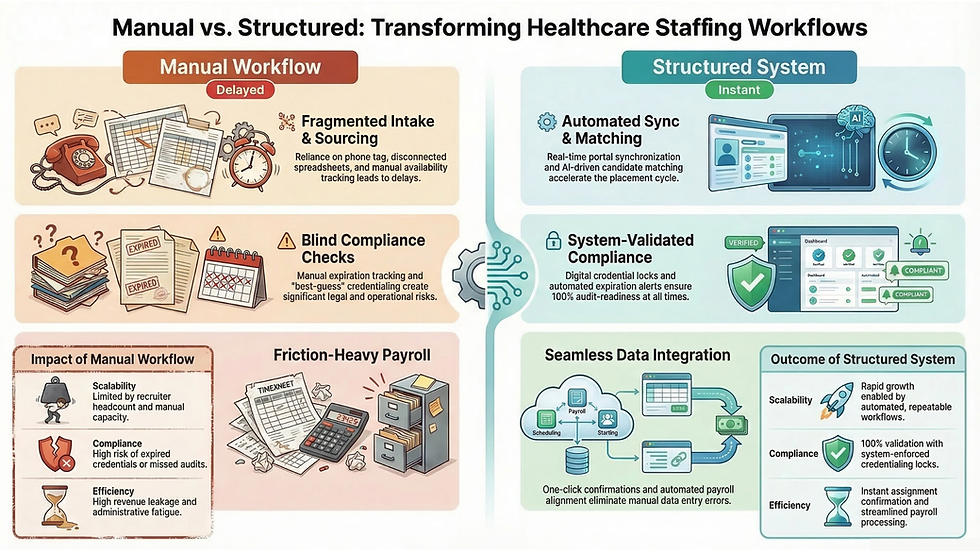
How do you avoid compliance issues during scheduling?
Scheduling without compliance checks is risky.
We’ve seen issues like:
Expired licenses
Missing documents
Failed audits
What works better is embedding compliance inside scheduling using healthcare employee scheduling software that includes credential management and compliance tracking to validate eligibility before assignment. So validation happens before deployment, not after.
How scheduling connects to payroll (and where money leaks)
Scheduling errors don’t stay in ops; they hit finance.
Common issues:
Wrong rates
Missed overtime
Billing disputes
Manual corrections
When systems are aligned through integrated payroll and scheduling software
Payroll becomes accurate
Rates are consistent
Over time is visible early
Key takeaway:
Disconnected systems quietly eat your margins.
Where Vars Health fits in a real agency setup
Most agencies don’t lack tools.
They lack a connection between tools.
That’s where a unified healthcare staffing platform comes in.
It connects:
Scheduling
shared shift board
live availability
faster confirmations
Compliance
Handled through automated compliance validation workflows
Finance
Payroll sync
Rate accuracy
Overtime tracking
Leadership visibility
Fill rates
Time-to-confirm
Utilization
Reality check:
Software doesn’t fix broken processes.
It amplifies good ones.
Is scheduling software actually worth it?
Small agencies → manageable manually
Growing agencies → bottlenecks appear
Scaling agencies → it becomes critical
At that point, you need scalable healthcare staffing solutions for agencies
What should you fix before implementing scheduling software?
Map your current workflow
Compare with healthcare staffing workflows and best practices
Identify bottlenecks
Where do things slow down?
Define ownership
Who owns each step?
Align scheduling + payroll
If disconnected, problems continue.
Pro tip:
Fix the process first. Then add the tool.
FAQ – Healthcare Scheduling Software for Staffing Agencies
How long does implementation take?
Typically 4–12 weeks, depending on complexity.
What features matter most?
Real-time availability
Conflict detection
Compliance validation
Fast confirmations
Payroll alignment
Can small agencies benefit?
Yes, especially as volume grows.
Does it replace recruiters?
No. It removes manual coordination work.
How does it improve fill rates?
By reducing delays and improving response speed.
Final takeaway for staffing agency owners
Scheduling is not just an ops function.
It directly impacts:
Revenue
Compliance
Client trust
If things feel slow or messy right now:
👉 Map your workflow
👉 Find where it breaks
👉 Then evaluate if you need an end-to-end healthcare workforce platform
That clarity alone will tell you what to fix next.


