
Healthcare Workforce Management Software Solutions: What's Right for You?

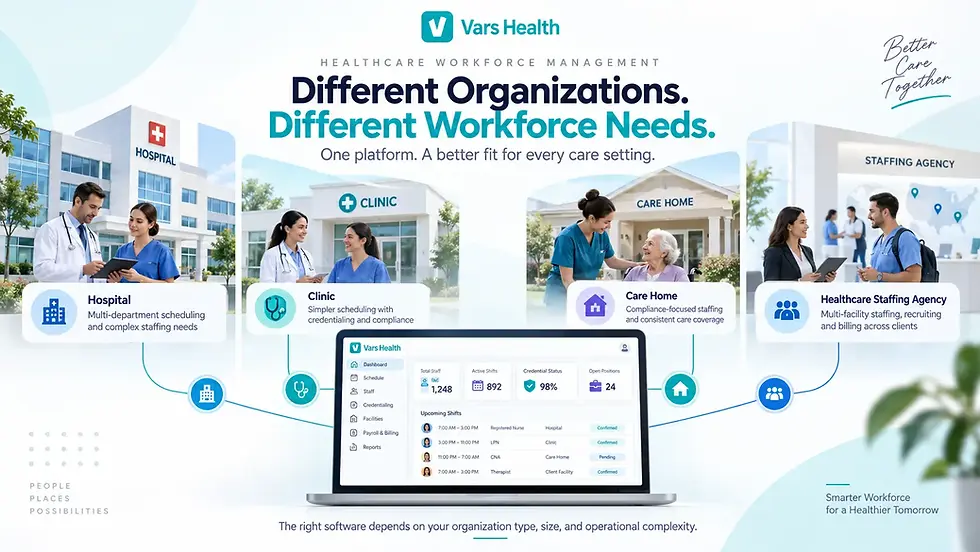
Different healthcare organizations need genuinely different things from workforce management software, and treating this as a one-size-fits-all category leads to mismatched expectations. This article breaks down how needs differ by organization type and size, to help identify what actually matters for a specific situation.
How do needs differ between a hospital, a clinic, and a care home?
Organization type shapes workforce management priorities more than any single feature list can capture:
Hospitals typically need robust multi-department scheduling, complex shift patterns across specialties, and integration with larger EHR systems
Clinics often prioritize simpler scheduling with fewer shift variations, but still need solid credentialing tracking given the same regulatory exposure at smaller scale
Care homes frequently need strong compliance documentation given higher regulatory scrutiny, alongside scheduling that accounts for consistent staff-to-resident ratios
Key takeaway for operations leaders: the right solution isn't the one with the most features, it's the one whose core strengths match your organization's actual operational shape.
How should a staffing agency's needs differ from a direct healthcare employer's needs?
This distinction matters more than organization size in many cases. A staffing agency placing clinicians across multiple client facilities needs facility-specific compliance configuration and cross-facility scheduling visibility that a direct employer, managing only its own staff at one or a few locations, doesn't require in the same way. Conversely, a direct employer may prioritize deeper integration with its own single EHR system more than a staffing agency serving facilities on varied systems would.
Organization Type | Primary Need |
Healthcare staffing agency | Facility-specific compliance profiles, cross-facility scheduling, multi-client billing |
Direct healthcare employer | Deep single-EHR integration, internal department scheduling, employee (not contractor) payroll structures |

What should organizations of different sizes prioritize differently?
Size affects which features deliver the most value relative to their complexity:
Small organizations (under 50 staff or clinicians) should prioritize core credentialing and scheduling functionality over advanced features like AI-assisted matching, which deliver less relative value at smaller scale
Mid-size organizations (50-200) typically benefit most from payroll and billing integration, since manual reconciliation becomes genuinely costly at this scale
Larger organizations (200+) often need the fuller feature set, including predictive scheduling and advanced reporting, since manual processes break down more severely at this volume
Common operational mistake: a small organization purchasing an enterprise-tier platform with extensive features it doesn't yet need, when a simpler configuration would deliver the same core value at lower cost and complexity.
How does this bridge between informational research and a commercial decision?
Understanding which category an organization falls into is the bridge between general research and an actual vendor conversation. Rather than researching "best healthcare workforce management software" broadly, the more productive framing is "best healthcare workforce management software for [organization type] at [approximate size]," since this narrows the relevant comparison set significantly and avoids evaluating features that don't actually apply to the situation.
Where does Vars Health fit into this decision framework?
Vars Health is built specifically for healthcare staffing agencies managing recruiting, credentialing, scheduling, time tracking, and payroll/billing across multiple client facilities, rather than for direct healthcare employers managing only internal staff. For an organization using this framework to identify its own category, the practical next step is confirming that framing with any vendor under consideration, since a mismatch between organization type and platform design tends to surface as friction later, even when initial demos look promising.
What signals suggest an organization has outgrown its current solution?
A few patterns suggest a mismatch between an organization's current software and its actual needs, regardless of which category it falls into:
Staff building workarounds outside the platform, like maintaining a parallel spreadsheet because the software doesn't handle a specific need well
Manual reconciliation tasks growing rather than shrinking as the organization adds facilities or staff, suggesting the platform isn't scaling with actual operational complexity
Compliance incidents that trace back to visibility gaps, rather than genuine oversight failures, indicating the software isn't surfacing risk proactively enough for the organization's current scale
What usually breaks at scale: organizations that selected software matched to their needs at a smaller size sometimes delay re-evaluating fit as they grow, absorbing increasing manual workaround costs rather than recognizing the mismatch has become the actual problem.
How should an organization weigh switching costs against a better-fit solution?
Recognizing a mismatch doesn't automatically mean switching is the right call immediately. The switching cost, in migration effort and disruption risk, needs to be weighed against the ongoing cost of the current mismatch. A useful framing: if the current manual workaround costs are growing and show no sign of leveling off, the case for switching strengthens over time rather than staying static, which argues for evaluating sooner rather than waiting for the mismatch to become more costly.
Frequently asked questions
1. Can the same software work well for both a staffing agency and a direct healthcare employer?
Some platforms serve both reasonably well, but the core architecture often reflects one primary use case more strongly. It's worth asking directly which type of organization a platform was originally built to serve.
2. Does organization size matter more than organization type when choosing software?
Both matter, but type often has a larger effect on which core features are actually relevant, while size affects how much of the feature set delivers proportional value.
3. How can an organization determine which category it falls into if it doesn't fit neatly?
Organizations with mixed characteristics, like a staffing agency that also directly employs some clinical staff, should prioritize whichever operational model represents the larger share of their actual workforce management needs.
Key takeaway
The right healthcare workforce management solution depends heavily on organization type and size, and the practical starting point is identifying which category best describes your organization before evaluating specific vendors, rather than comparing platforms against a generic feature checklist.


