
All-in-One Staffing Agency Software: Manage Hiring, Scheduling, and Payroll
Updated: Apr 22

Running a staffing agency in 2025 means managing dozens of moving parts at the same time: sourcing candidates, tracking credentials, scheduling shifts, processing payroll, and staying compliant, often across multiple clients and locations. When these functions live in disconnected tools, things break. Candidates fall through the gaps. Compliance deadlines get missed. Payroll errors create disputes. The result is a slower, more expensive operation than it needs to be.
Staffing agency software addresses this by connecting the core functions of your agency into a single operational platform. This article walks through what that actually looks like in practice: the pain points it solves, the features that matter most, and what to realistically expect when you start using one.
Why do most staffing agencies still struggle with disconnected tools?
The honest answer is that most agencies built their tech stack one problem at a time. They added an ATS for staffing agencies when recruiting volume grew. They moved to a spreadsheet for credential tracking when someone almost missed a license expiration. They subscribed to a payroll tool when the manual process broke down under scale.
The result is a patchwork: an ATS that does not talk to payroll, a compliance tracker that no one updates consistently, and an onboarding checklist that lives in someone's email drafts.
WHAT USUALLY BREAKS AT SCALE
The handoff between recruiting and credentialing is the most common failure point. A recruiter marks a candidate "ready," but the credentialing team has not verified the license or received the TB test results. The candidate gets scheduled. The client calls with a compliance issue. The agency scrambles.
This is not a people problem. It is a visibility problem. When teams cannot see what stage every candidate is at, from application through deployment, errors compound over time.
What does an all-in-one staffing agency software platform actually include?
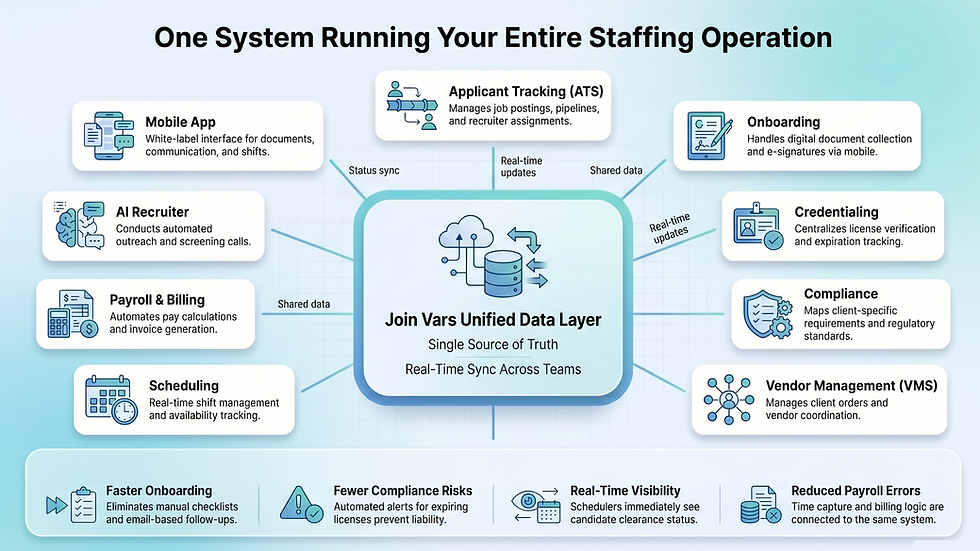
A purpose-built platform like Join Vars (the software suite from Vars Health) is designed to cover the full lifecycle of a candidate from first contact to active deployment, with the compliance and billing infrastructure built in.
Here is what that looks like across the core modules, and how these align with the key features of staffing software for agencies:
Module | What it handles | Operational impact |
Job postings, application pipeline, recruiter assignments, candidate status | Shorter time-to-fill, fewer dropped applications | |
Document collection, e-signatures, orientation materials, task checklists | Faster time-to-deploy, fewer back-and-forth emails | |
Credentialing | License verification, expiration tracking, document storage | Fewer compliance incidents, audit-ready records |
Regulatory tracking, certification renewals, client-specific requirements | Reduced liability, cleaner client relationships | |
Shift management, availability, deployment tracking | Better fill rates, lower no-show rates | |
Time capture, pay calculations, invoice generation, client billing | Fewer payroll errors, faster invoice cycles | |
Automated outreach, screening calls, candidate follow-up | Recruiter capacity freed up for complex tasks | |
Candidate-facing app for document uploads, shift viewing, communication | Faster onboarding, better candidate experience | |
Client order management, vendor coordination, reporting | Stronger client visibility, scalable multi-client ops |
KEY TAKEAWAY FOR OPERATIONS LEADERS
The value of an integrated platform is not just feature count. It is that every team is looking at the same data. When a credentialing coordinator marks a document as verified, the scheduler can immediately see the candidate is deployment-ready. That handoff, which used to involve an email or a Slack message or a phone call, just disappears.
How can staffing agencies fix slow candidate onboarding without adding headcount?
Onboarding delays are one of the most common complaints we hear from operations leaders at staffing agencies, particularly in healthcare. A candidate accepts an offer and then waits five, seven, or sometimes ten days before they are cleared to work. During that window, they might take another offer. The agency loses a placement. The client is short-staffed.
The problem is almost always the same: onboarding is manual. A coordinator emails a document checklist. The candidate does not see it immediately. They upload the wrong version of a license. The coordinator catches it on day three. The process resets.
What a software-driven onboarding workflow looks like instead
Candidate accepts the offer and immediately receives a digital onboarding packet through the white label mobile app
Required documents are listed clearly with upload prompts directly in the app
The system auto-checks for document completeness and flags missing items in real time
The credentialing team receives an automatic notification when all documents are submitted
License verification runs through the platform's credentialing module
Once cleared, the candidate's status updates, and the scheduler is notified automatically
PRO TIP FOR STAFFING AGENCIES
Map your current onboarding steps before you configure any software. The platform will match your workflow, not the other way around. If you have ten redundant steps, you will automate them and wonder why it is still slow.
For a practical starting point, see how a modernized onboarding process changes what agencies can realistically automate first.
In real implementations, the biggest bottleneck is usually document collection, not verification. Giving candidates a clean mobile experience with clear upload instructions cuts the back-and-forth by a significant margin. Understanding how healthcare staffing software revolutionizes onboarding shows exactly where each delay gets removed from the process.
How do healthcare staffing agencies manage credentialing at scale without manual tracking?
Credentialing in healthcare staffing is non-negotiable. A nurse placed without a verified, active license is a liability event. A CNA whose TB test expired last month should not be on a client's schedule. But when you are managing hundreds of active workers across multiple clients, tracking renewals manually is a full-time job with a high error rate. Agencies using a staffing agency software stack purpose-built for this avoid the compounding failure that manual tracking produces.
This is also why compliance tracking for staffing agencies needs to be an active, ongoing process rather than a one-time check at hire. The credentialing module in a platform like Join Vars centralizes this entirely:
Every license, certification, and compliance document is stored in one place per candidate
Expiration dates are tracked automatically with configurable alerts before a document expires (30, 60, or 90 days out)
Client-specific requirements are mapped, so the system knows what each facility expects
Verification status is visible to every team in real time
COMMON OPERATIONAL MISTAKE
Agencies often treat credentialing as a one-time event at hire. Licenses expire. Certifications lapse. If your system only tracks what was verified on day one, you will eventually schedule someone who is no longer compliant.
One operations lead at a mid-size travel nurse staffing agency described it this way: her team was spending about four hours a week just pulling spreadsheets, checking state licensing board websites, and emailing workers for renewal reminders. After moving to a centralized credentialing module, that time dropped to less than 30 minutes of reviewing flagged alerts. This is consistent with what agencies see when they adopt healthcare credentialing automation at scale.
What is the right way to handle payroll and billing across multiple clients in a staffing agency?
Payroll errors are expensive. Understanding how staffing billing software handles multi-client rate structures is key to eliminating this risk. A miscalculated overtime rate, a missed shift differential, or a billing line item that does not match the client's timesheet creates disputes that take hours to resolve and damage the agency-client relationship. When you are running payroll for 50, 100, or 500 workers across multiple clients with different rate structures, the math gets complicated fast.
The payroll and billing module in an integrated platform handles this by:
Capturing time directly through the mobile timekeeping module, reducing manual entry errors
Applying client-specific bill rates and worker-specific pay rates automatically
Generating invoices tied directly to approved timesheets
Flagging discrepancies before payroll runs rather than after
Connecting billing data to reporting so margins are visible in real time
This matters most for agencies that are growing. At 20 workers, a spreadsheet is manageable. At 200, a single formula error can affect 15 paychecks. The platform removes that risk by making time data, pay rules, and billing logic part of the same connected system. For a deeper breakdown, see a comparison of the best payroll software for staffing agencies.
How does AI technology actually help recruiters at staffing agencies day to day?
There is a lot of noise around AI in staffing. Here is what it realistically helps with and where it does not replace human judgment.
The AI Voice Recruiter in Join Vars handles initial outreach and screening at scale. When a recruiter has 80 candidates to contact for a shift or a new job opening, the AI can make those first-touch calls, ask qualifying questions, and update the candidate's status in the ATS automatically. The recruiter then focuses their time on the candidates who responded positively and need a real conversation.
The AI candidate matching feature cross-references open orders against candidate profiles, credentials, availability, and history to surface the most deployment-ready matches first. The recruiter is not sorting through every profile manually.
PRO TIP FOR STAFFING AGENCIES
AI tools work best when your candidate data is clean and current. If your profiles are incomplete or out of date, the matching will surface poor-fit candidates. Fix your data hygiene first.
See how clean data drives faster hiring in healthcare staffing for a practical starting point before enabling AI features.
Should smaller staffing agencies invest in software, or is it only worth it at scale?
This is a fair question. The honest answer is: it depends on where your operational pain is, not how big you are.
A 15-person agency managing 150 active healthcare workers across three hospital clients can be just as overwhelmed by manual credentialing and scheduling as a 100-person agency, often more so, because there is less administrative bandwidth to absorb errors.
The real question is not size. It is:
Are you losing candidates during onboarding because the process is slow or confusing?
Are you spending more than two hours a week on manual credential tracking?
Are payroll or billing errors causing disputes more than once a month?
Does your recruitment CRM for staffing agencies operate as a disconnected tool, leaving recruiters doing more data entry than actual recruiting?
If yes to two or more of these, a platform like Join Vars will have a measurable return quickly, not years down the road.
What is the right order to implement staffing agency software without disrupting operations?
Most agencies try to switch everything at once and run into problems. A phased approach works better:
Phase 1: Fix the broken handoffs first
Start with onboarding and credentialing. These are typically where the most candidate attrition and compliance risk live. Getting digital onboarding and centralized credential tracking in place first gives you immediate, visible impact.
Phase 2: Connect scheduling and deployment
Once candidates are moving through onboarding cleanly, connect the healthcare scheduling software, so deployment-ready candidates are visible to your scheduling team immediately.
Phase 3: Integrate payroll and billing
Connecting staffing payroll services last makes sense because it requires the most configuration around your rate structures and client contracts. By this point, your time data is cleaner, and the integration is less risky.
Phase 4: Layer in AI tools and reporting
AI matching and the AI Voice Recruiter add the most value once your base data is structured and your workflows are running through the platform. For a practical guide, see how agencies are choosing and implementing AI tools for staffing without disrupting existing workflows.
COMMON OPERATIONAL MISTAKE
Trying to automate a broken process. If your onboarding checklist has gaps and your credential tracking is incomplete, software will speed up a broken workflow.
Exploring digital transformation strategies for staffing agencies first helps you map what needs fixing before configuration begins.
Frequently Asked Questions
How long does it typically take to implement healthcare staffing software?
Most agencies can get core modules like onboarding, credentialing, and scheduling live within four to eight weeks. Full integration including payroll, billing, and AI tools typically takes two to four months depending on the complexity of your client contracts and rate structures. A phased rollout reduces disruption significantly.
What features matter most for compliance tracking in a staffing agency?
Expiration-based alerts on licenses and certifications, client-specific requirement mapping, and a single centralized document record per worker are the three non-negotiables. See the full breakdown of key features in healthcare staffing software for a complete checklist. Everything else builds on top of those three foundations.
Can a small staffing agency benefit from an all-in-one platform?
Yes, particularly in healthcare. The compliance risk is the same regardless of agency size. A small agency managing 50 nurses has the same credentialing obligations as a large one. The manual overhead is often proportionally heavier for smaller teams, which makes software more impactful, not less.
How does staffing agency software reduce onboarding time specifically?
By eliminating email-based document collection, giving candidates a mobile interface to upload directly, auto-flagging missing or incorrect documents, and connecting the onboarding status to the credentialing and scheduling modules without manual handoffs. You can see this mapped step by step in the guide to top employee onboarding software solutions. Each step removes a delay that compounds in a manual workflow.
Is a vendor management system (VMS) necessary for mid-size agencies?
If you work with more than three or four clients and manage multiple open orders at once, a VMS becomes operationally valuable. It gives you visibility into client order status, candidate placement, and fill rate reporting. The benefits of vendor management software are explained in detail for agencies weighing this decision against their current operational overhead.
What is the difference between recruitment software and staffing agency software?
Recruitment software typically covers the ATS side: posting jobs, managing applicants, and tracking candidate pipelines. Staffing agency software goes further and covers the post-placement workflow, including credentialing, onboarding, scheduling, timekeeping, payroll, and compliance. For staffing agencies, recruitment is only one part of the operation.
Does Join Vars work for non-healthcare staffing agencies?
The platform is built with healthcare compliance complexity in mind, but the core modules apply to any staffing vertical. Agencies in light industrial staffing, IT staffing, or professional services have used the platform successfully, particularly the scheduling and billing functionality.
Where to start if you are evaluating staffing software
The most useful first step is not a demo. It is an honest audit of where your current process actually breaks down. Spend 30 minutes mapping your candidate lifecycle from application to first shift, and mark every step where something gets dropped, delayed, or manually re-entered.
That map will tell you which modules matter most for your operation, and in what order to prioritize them. Once you have that, evaluating a platform like Join Vars against your specific pain points is a much more productive conversation than a generic feature walkthrough.
Vars Health builds software for staffing agencies that want to run tighter operations without adding administrative headcount. If you want to see how the platform fits your specific workflow, the team at varshealth.com can walk you through a scenario-based review of your current process.


