AI Recruiting for Healthcare: The Complete Guide


Healthcare staffing agencies are getting more applications than ever, and recruiters have less time than ever to work through them. That's the tension behind almost every question in this guide: how do you screen faster, respond faster, and stay compliant, without losing the human judgment that placements actually depend on.
AI recruiting for healthcare means using software, voice AI, and automated matching to handle the repetitive parts of hiring nurses, allied health professionals, and other clinicians, so recruiters spend their time on conversations that lead to placements instead of data entry and phone tag.
This guide covers what AI recruiting actually does in a healthcare staffing agency, where it fits into a real recruiting workflow, and where it doesn't replace the human side of the job.
What does AI recruiting actually do in a healthcare staffing agency?
In a mid-size travel nurse staffing agency we worked with, recruiters were losing close to two hours a day just re-asking the same five screening questions to every applicant: license state, specialty, shift preference, availability date, and certifications. That's not recruiting. That's data collection with a human doing the typing, and it's the same gap covered in our breakdown of what separates an ATS from general recruiting software.
AI recruiting tools take over that layer of work. In practice, that usually looks like:
Resume and application parsing. Software reads incoming applications and pulls out license numbers, specialties, years of experience, and certifications, then checks them against the job requirements automatically.
Automated screening conversations, by chat, text, or voice, that ask the standard questions and log answers before a recruiter ever picks up the phone.
Candidate-to-job matching, ranking applicants against open orders based on credentials, availability, and location instead of a recruiter manually cross-referencing a spreadsheet.
Outreach and re-engagement, automatically following up with candidates who went quiet, since ghosting is one of the biggest volume killers in healthcare staffing.
Pro tip for staffing agencies: audit which of these four steps is actually eating your recruiters' time before buying anything. Agencies often assume they need matching automation when the real bottleneck is screening.

How AI voice screening changes healthcare recruiting
Voice is a newer piece of this, and it's worth calling out on its own because it maps to a real, specific problem: phone tag.
A recruiter calls a candidate, no answer, leaves a voicemail, candidate calls back an hour later, recruiter is in another interview. Repeat that across 40 open reqs and a recruiter's day is mostly missed connections.
AI voice screening tools answer or place calls around the clock, ask the same screening questions a recruiter would, and log the responses in real time. Vars Health's AI voice assistant, for example, greets the caller, walks through predefined job requirements, and hands off to a human recruiter the moment the conversation needs judgment, like negotiating pay or handling an unusual availability request.
Common operational mistake: treating voice AI as a replacement for the recruiter relationship instead of a front door to it. The agencies that get the most out of it use AI to reach and pre-qualify candidates fast, then get a human on the phone quickly once someone is a real fit.
How does AI recruitment software reduce time-to-hire in healthcare?
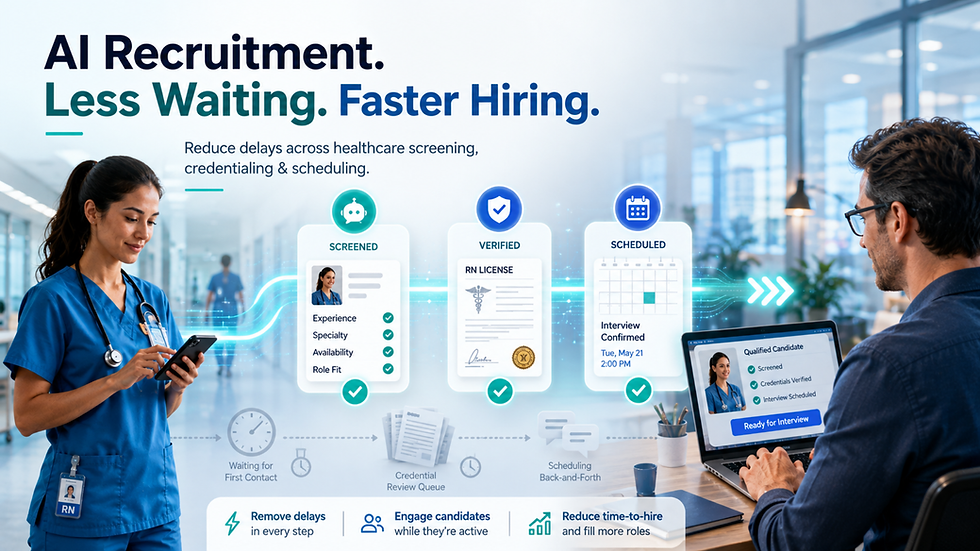
Time-to-hire in healthcare staffing has a few specific chokepoints: initial screening, credential verification, and interview scheduling. Each one adds days, and candidates who are strong enough to place quickly are usually talking to more than one agency at the same time.
AI recruitment software compresses the first two of those:
Screening happens automatically instead of waiting for a recruiter's next open slot
Credential and license data gets verified as soon as it's submitted, rather than sitting in a queue for manual review
Interview availability gets captured through chat or text and synced to a recruiter's calendar instead of a round of "does Tuesday at 2pm work?" emails
One operations lead we spoke with put it simply: the agencies losing candidates aren't losing them on pay. They're losing them on speed. A candidate who hears back in four hours instead of four days takes the first real offer.
Key takeaway for operations leaders: time-to-hire gains from AI come from removing wait time between steps, not from making any single step faster. Map your current process end to end before assuming which stage needs automation.
What hospitals need to know about AI recruitment compliance in healthcare staffing
This is the question that comes up once a hospital or health system's IT and security team gets involved in evaluating a staffing partner or a recruiting tool.
The honest answer: AI recruiting tools handle candidate data, which means they touch the same compliance surface as any other system with PHI-adjacent or sensitive personal information. Before adopting one, an agency or health system should confirm:
Where candidate data is stored and who can access it
Whether the vendor supports SOC 2 or HIPAA-aligned practices, and what that actually covers in their environment
How license and certification data is verified, not just collected
Whether the AI's screening decisions are logged and auditable, since credentialing and hiring decisions in healthcare need a paper trail
What usually breaks at scale: agencies adopt an AI screening tool for speed and don't ask these questions until a client's compliance team asks first. It's a much easier conversation when the answers already exist.
Is AI recruiting software worth it for mid-size healthcare staffing agencies?
Mid-size agencies are often the group most likely to actually benefit, and most likely to underinvest because the tools get marketed at enterprise staffing firms.
A small agency filling a handful of roles a month can usually still manage screening manually. A large enterprise firm has the budget and the internal team to build custom automation. Mid-size agencies, filling dozens to low hundreds of roles monthly with a lean recruiting team, are exactly where the math works best: enough volume that manual screening is a real bottleneck, not enough headcount to throw more recruiters at it.
The honest caveat: software alone doesn't fix a broken process. If job orders are unclear, if candidate data is scattered across spreadsheets and email threads instead of a shared recruitment CRM, AI recruiting tools will surface those gaps faster, not fix them. Fix the process first, then let the software carry the repetitive load. For a closer look at how the screening and scheduling side works day to day, see our look at AI recruiting software for healthcare staffing agencies.
Where AI fits versus where process still matters
It's worth being direct about this, because a lot of vendors aren't. AI recruiting software is genuinely good at repetitive, rules-based work: screening, matching, logging, and following up. It is not a substitute for a recruiter's judgment on borderline candidates, pay negotiation, or reading whether someone is actually going to show up for a shift. Agencies that get the most value treat AI as the layer that clears the routine work off a recruiter's desk, not as a way to reduce headcount to zero.
AI recruiting for healthcare: Frequently asked questions
1. What is AI recruiting in healthcare staffing?
It's the use of software and voice AI to automate screening, credential checks, candidate matching, and outreach for hiring nurses and other clinicians, reducing manual recruiter workload on repetitive steps.
2. Does AI recruiting replace healthcare recruiters?
No. It handles high-volume, repetitive tasks like initial screening and follow-up. Recruiters still handle relationship-building, negotiation, and judgment calls on candidate fit.
3. How long does it take to implement AI recruiting software in a staffing agency?
Most agencies can get core screening automation running within a few weeks. Full integration with existing ATS and credentialing workflows typically takes longer, depending on how clean the existing candidate data is.
4. Is AI recruiting software HIPAA-compliant?
Compliance depends on the specific vendor's infrastructure and practices, not on AI recruiting as a category. Confirm data handling, storage, and audit logging directly with any vendor before adopting a tool.
5. Can small staffing agencies benefit from AI recruiting tools?
Smaller agencies with lower application volume may see less immediate value than mid-size or larger agencies, but voice screening and automated follow-up can still help reduce ghosting and speed up response times even at smaller scale.
Where to go from here
If you're evaluating whether AI recruiting fits your agency, the first useful step isn't picking a tool. It's mapping your current hiring process end to end and marking where candidates actually drop off or where recruiters lose the most time, from first screening through candidate onboarding. That's the bottleneck AI should solve first, and it's usually not the one agencies assume going in.