How AI Voice Screening Is Changing Healthcare Recruiting


A recruiter at a mid-size per diem staffing agency told us she spends the first two hours of every shift just returning missed calls from applicants. Half the time, by the time she reaches them, they've already accepted a shift with a different agency. That's the exact gap AI voice screening was built to close.
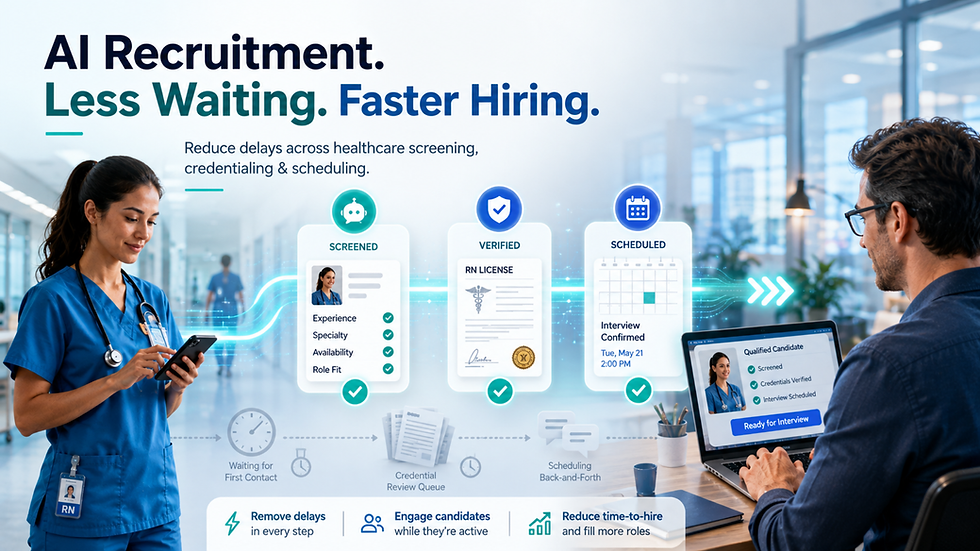
Healthcare recruiting with AI voice calls means using an automated voice assistant to answer, place, and conduct initial screening calls with candidates, capturing licensing, specialty, and availability information before a human recruiter ever joins the conversation.
How does AI voice screening actually work in a staffing agency?
The mechanics are simpler than most recruiters expect. When a candidate applies or a recruiter needs to reach a pool of clinicians about an open shift, the AI voice assistant places or answers the call, greets the person naturally, and works through a set of predefined screening questions: license state and number, specialty, years of experience, shift preference, and availability window.
The AI evaluates the answers against the job's requirements in real time. If the candidate is a fit, the system organizes their responses and flags them for a recruiter. If the conversation needs judgment, like negotiating pay above the posted rate or handling an unusual scheduling request, it hands off to a human recruiter directly.

Pro tip for staffing agencies: the highest-value use case isn't inbound screening, it's outbound. Agencies get the most out of voice AI when they use it to proactively call through a candidate pool for an urgent shift, instead of waiting for applicants to call in.
What problem does this actually solve?
Phone tag. In healthcare staffing, candidates are often talking to two or three agencies for the same type of role, and the agency that reaches them first, with a clear answer, usually wins the placement.
A recruiter can't be on the phone at 11pm when a night-shift nurse becomes available to talk. An AI voice assistant can. It runs continuously, so a candidate calling back at an unusual hour, or an agency reaching out at scale for an urgent opening, doesn't depend on a recruiter's calendar.
Common operational mistake: agencies sometimes deploy voice AI and then don't change anything else about their process, expecting it to fix a slow pipeline by itself. Voice screening removes one wait point. It doesn't fix a broken handoff between screening and scheduling, or a credentialing step that still takes days. For the bigger picture on where automation fits across the whole hiring process, see our complete guide to AI recruiting for healthcare.
What does this look like with Vars Health specifically?
Vars Health's AI voice assistant greets callers, introduces available roles based on the agency's open orders, and asks the same screening questions a recruiter would ask, using the job's predefined requirements. It captures responses in real time, evaluates qualifications, certifications, and availability, and organizes the data for the recruiter's review instead of leaving it in a voicemail transcript.
Every conversation is recorded and synced to the agency's system automatically, so a recruiter picking up a lead the next morning has the full context instead of starting from scratch. For complex requests or advanced questions, the assistant transfers the call to a human recruiter directly rather than trying to close the conversation itself.
Key takeaway for operations leaders: the value isn't that the AI replaces the screening conversation. It's that the conversation happens immediately instead of days later, and the recruiter picks up with full context instead of a cold voicemail.
Does AI voice screening feel impersonal to candidates?
This is the most common hesitation we hear, and it's worth answering honestly. Some candidates do notice they're speaking with an automated assistant. What tends to matter more to them, in our experience, is speed and clarity: getting an answer about a role the same day beats a personal touch three days later.
The agencies that get pushback are usually the ones that never get a human into the conversation once a candidate is a real match. Voice AI works best as the front door, not the entire house. A recruiter should still make the actual offer, answer pay questions in detail, and build the relationship that leads to repeat placements.
What usually breaks at scale: agencies roll voice screening out to every candidate interaction, including high-value candidates who were already engaged and ready to talk to a recruiter directly. Reserve automation for the volume layer, first-contact screening and reactivating cold leads, and keep warm, engaged candidates on a fast path to a human.
Is voice AI worth it for smaller staffing agencies?
Smaller agencies filling a modest number of shifts a month may not see the same drop in recruiter workload that a high-volume agency does, since they aren't drowning in inbound calls to begin with. But even smaller agencies tend to see a real benefit on two things: reduced ghosting, since candidates get an immediate response instead of a callback days later, and after-hours coverage, since urgent shift requests and last-minute openings don't have to wait for business hours.
AI voice screening: frequently asked questions
1. What is AI voice screening in healthcare recruiting?
It's the use of an automated voice assistant to conduct initial candidate screening calls, asking standard questions about licensing, specialty, and availability, and logging the responses for a recruiter to review.
2. Does AI voice screening replace phone interviews with recruiters?
No. It handles the first-contact screening layer. Recruiters still conduct the substantive conversations around offers, pay, and scheduling once a candidate is a confirmed fit.
3. How quickly can an agency set up AI voice screening?
Most agencies can have basic screening questions and workflows configured within a few weeks, depending on how clearly job requirements and screening criteria are already defined.
4. Can AI voice screening handle multiple healthcare specialties at once?
Yes. Screening questions are built around each job's specific requirements, so the same system can screen for an ICU RN opening and a physical therapist opening with different question sets.
Where to start
If your agency is losing candidates to competitors who simply call back faster, voice screening is worth evaluating for that reason alone. Start by tracking how long it currently takes a recruiter to make first contact with a new applicant, then compare that number to how quickly your best-performing recruiters close a placement. That gap is usually the clearest business case for automating the first call.