
How AI Recruitment Software Reduces Time-to-Hire in Healthcare

An operations lead at a staffing agency we worked with pulled her numbers for one quarter and found something uncomfortable: the agency wasn't losing candidates on pay. It was losing them on speed. Candidates who fit three or more open roles were taking whichever offer came back first, and that was rarely her agency's offer.
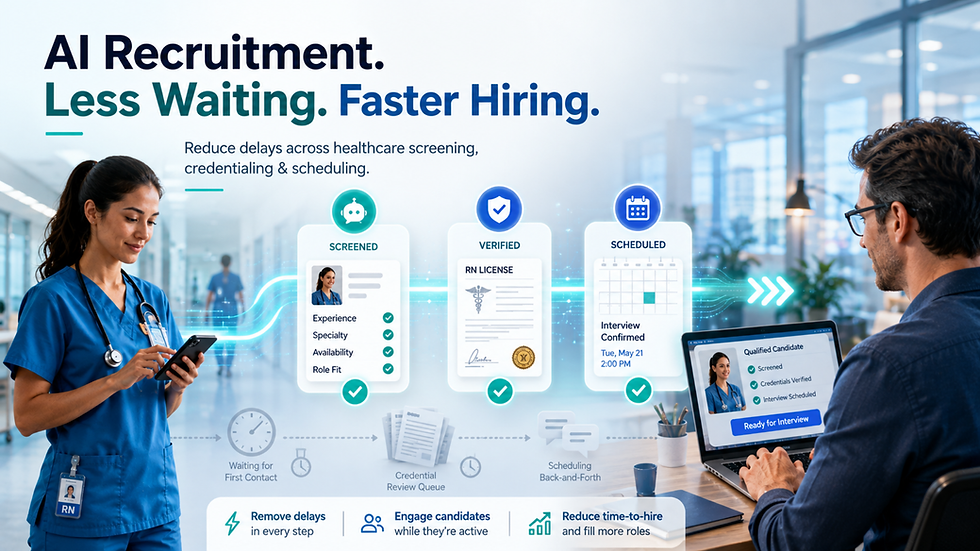
AI recruitment software reduces time-to-hire in healthcare staffing by automating the slowest parts of the pipeline: screening, credential verification, and interview scheduling, so a qualified candidate hears back in hours instead of days.
Where does time actually get lost in healthcare hiring?
Time-to-hire in healthcare staffing rarely gets lost in one dramatic bottleneck. It leaks out in a series of small waits:
A candidate applies at 6pm and doesn't get a screening call until the next recruiter shift starts
A license or certification sits in a manual verification queue for a day or two before anyone checks it
Interview scheduling turns into three or four back-and-forth messages to find a time that works

None of these individually feels like a crisis. Added together across a hiring cycle, they can turn a role that should close in three days into one that takes ten.
Pro tip for staffing agencies: map your actual hiring timeline stage by stage before assuming which one needs automation. Agencies often guess wrong about where the real delay is.
How does AI recruitment software close these gaps?
AI recruitment software works on the wait time between steps, not necessarily the steps themselves. In practice:
Screening happens through chat, text, or AI voice calls as soon as a candidate applies, instead of waiting for the next available recruiter slot
Credential and license data gets checked against requirements automatically as it's submitted, rather than sitting in a manual review queue
Candidates share their availability directly through automated scheduling, and that syncs to a recruiter's calendar without a round of emails
None of this removes the recruiter from the process. It removes the idle time between the moment a candidate is ready to move forward and the moment a recruiter actually engages with them.
What does a faster time-to-hire actually look like in practice?
Consider two versions of the same scenario. In the slower version, a nurse applies Monday evening. A recruiter calls Wednesday. Credentialing review finishes Friday. An interview gets scheduled for the following Tuesday. By then, the nurse has already accepted a role somewhere else.
In the faster version, the nurse applies Monday evening and is screened automatically within the hour. Her license verification runs in parallel instead of waiting in a queue. A recruiter reaches out Tuesday morning with a confirmed, pre-screened candidate ready for an interview slot she picked herself. The agency isn't doing anything fundamentally different. It's just not making the candidate wait between steps that don't require a human yet.
Key takeaway for operations leaders: time-to-hire gains come from compression, not from making any one step happen faster in isolation. The goal is removing the gaps between steps.
Common operational mistake: automating the wrong stage
Agencies sometimes assume the fix is speeding up interview scheduling, since that's the most visible back-and-forth. In our experience, the bigger loss usually happens earlier, in the time between application and first contact. A candidate who doesn't hear anything for two days has often already moved on before scheduling ever becomes a factor.
What usually breaks at scale: agencies automate screening and matching but leave credentialing as a fully manual step, so candidates still stall out at the same point they always did. Time-to-hire improvements only hold if every stage in the pipeline moves at a similar pace. One slow stage becomes the new bottleneck.
Is this worth pursuing for a mid-size agency specifically?
Mid-size agencies tend to see the clearest return here. A small agency filling a handful of roles a month can usually manage without automation. A large enterprise firm often already has dedicated staff and custom tooling for each stage. Mid-size agencies, filling dozens to low hundreds of roles a month with a lean team, are the ones losing the most time to manual handoffs between recruiters, credentialing staff, and schedulers, and are the ones with the least slack to absorb that loss. The same logic applies on the buyer side too, since health systems evaluating staffing partners increasingly ask about time-to-fill as part of vendor selection. For the fuller picture on where AI fits across the hiring process, see our complete guide to AI recruiting for healthcare.
Time-to-hire and AI recruiting: Frequently asked questions
1. How much can AI recruitment software actually reduce time-to-hire?
The reduction depends heavily on where an agency's current bottlenecks sit. Agencies with slow first-contact screening tend to see the biggest gains; agencies that already screen quickly but stall on credentialing see gains there instead.
2. Does faster time-to-hire mean lower quality candidates?
Not inherently. Automation handles verification and matching against defined requirements. It doesn't lower the bar for who qualifies. It removes the delay between a candidate qualifying and a recruiter knowing it.
3. What's the first step to reducing time-to-hire with AI recruitment software?
Map the current hiring timeline stage by stage: application, screening, credential check, interview scheduling, offer. Identify which stage has the longest average wait before targeting it with automation.
4. Does this work for high-volume travel nurse staffing specifically?
Yes, and volume is where the gains compound the fastest. High application volume means more candidates sitting in a screening queue, so the same automation removes more wait time proportionally.
Where to go from here
If time-to-hire is a real concern for your agency, start by timing your own pipeline honestly: from application to first recruiter contact, from first contact to credential clearance, from clearance to interview. Whichever stage has the longest average wait is the one worth automating first, not necessarily the one that feels the most manual.


