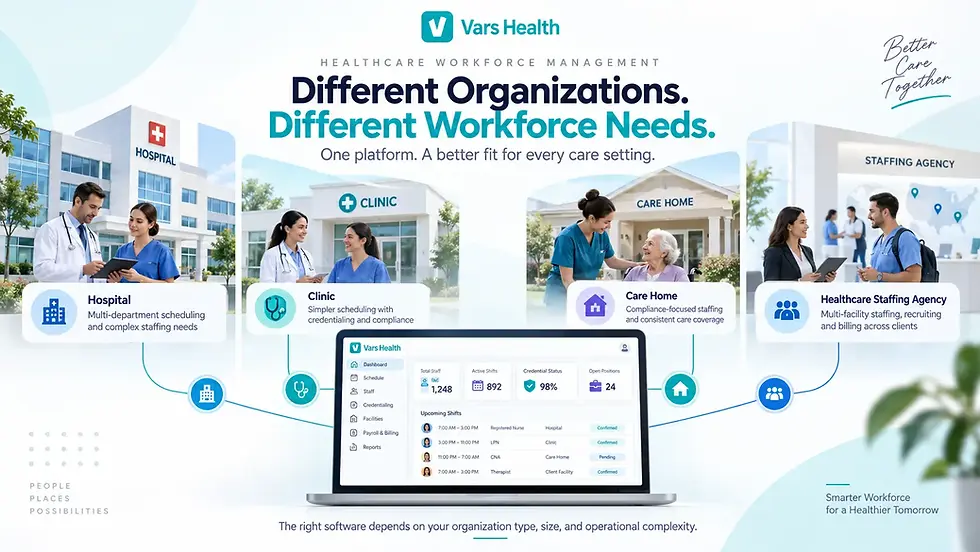
Best Healthcare Recruiting Software Platforms for Hospitals and Staffing Agencies

If you run a healthcare staffing agency and you’re still juggling spreadsheets, email threads, and disconnected tools to manage recruiting, credentialing, and compliance, you already know the problem. The real question is: which healthcare recruiting software actually solves it, and what should you look for before making a decision?
This guide breaks down what matters, what to ignore, and how purpose-built platforms compare to generic alternatives, so you can make a confident, informed choice.
Why Generic Recruiting Tools Break Down in Healthcare Staffing
Most general-purpose ATS platforms were built for corporate HR teams, not healthcare staffing agencies. The moment you introduce credentialing requirements, multi-facility scheduling, and state-by-state compliance tracking, they fall apart. See how a purpose-built healthcare staffing ATS differs.
Here’s what that looks like in practice:
A recruiter manually emails candidates for license uploads — creating follow-up chains that stretch onboarding to 3–4 weeks
Compliance documents are stored in Google Drive folders with no expiry tracking. This is exactly what automated credential management is built to fix.
Scheduling happens in one tool, payroll in another, and billing in a spreadsheet
Operations leaders have no real-time visibility into which candidates are deployment-ready
Common operational mistake: Choosing software that handles recruiting but ignores credentialing. In healthcare staffing, those two workflows are inseparable.
These aren’t edge cases. They are the standard pain points agencies face when they outgrow basic tools, or never had the right ones to begin with.
What Features Actually Matter in Healthcare Recruiting Software?
Before evaluating any platform, map your actual workflow: sourcing → recruiting → credentialing → onboarding → scheduling → payroll → billing. The right software should support every stage, not just the front end.
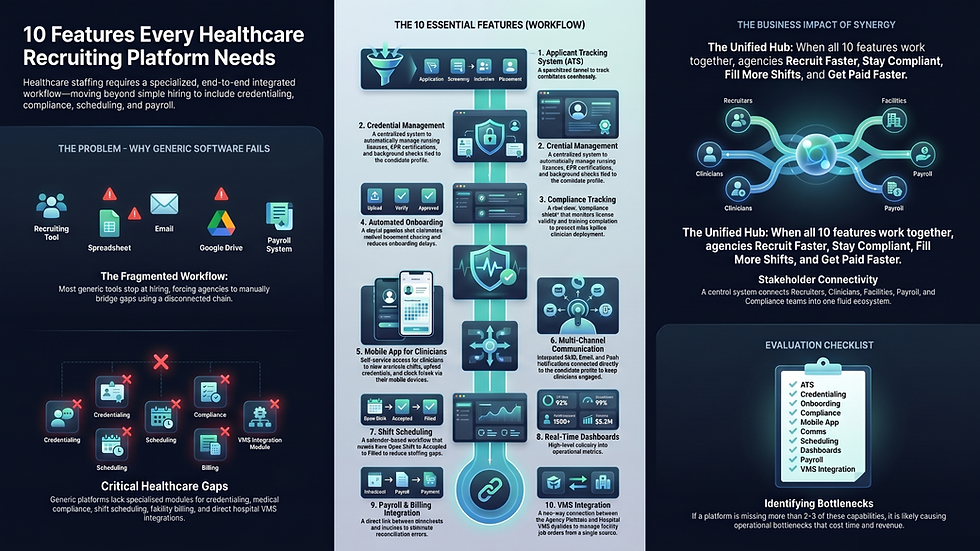
Here’s a practical feature checklist:
Feature | Why It Matters |
Applicant Tracking System (ATS) | Manages candidate pipeline from application to placement |
Credential & Document Management | Tracks licenses, certifications, and expirations automatically — see how credential & document management works in practice. |
Automated Onboarding | Reduces time-to-deploy by eliminating manual document collection |
Shift Scheduling & Management | Matches staff availability, skills, and compliance status to open shifts — explore healthcare scheduling software built for per diem and contract staffing. |
Payroll & Billing Integration | Eliminates double-entry and timesheet errors — learn how automated payroll for staffing agencies works end-to-end. |
Compliance Tracking | Ensures only credentialed, eligible staff are scheduled |
Mobile App for Clinicians | Enables self-serve shift picking, document uploads, and clock-in/out |
Real-Time Dashboards | Gives operations leaders visibility into fill rates, compliance status, and revenue |
Multi-Channel Communication | Email, SMS, and in-app messaging to keep clinicians engaged |
VMS Integration | Connects agency workflows to facility vendor management systems |
Pro tip for staffing agencies: Don’t evaluate software feature by feature in isolation. Evaluate it as a complete workflow. A great ATS connected to a weak credentialing module will still create bottlenecks.
How Should Healthcare Staffing Agencies Evaluate Recruiting Platforms?
When one operations manager at a mid-size per diem agency switched platforms, the biggest surprise wasn’t the features. It was the time saved on administrative tasks. Her team was spending roughly 3–4 hours per day on manual follow-ups, credential verification, and billing reconciliation. Those are the exact workflows covered in this guide to building the right staffing agency software stack. After moving to an integrated platform, those hours went back into recruiting.
That’s the real value of purpose-built healthcare recruiting software. It’s not about automation for its own sake. It’s about redirecting recruiter time toward billable work.
When evaluating platforms, ask these questions:
Does the platform support both per diem shift-based work and permanent/contract placements? If per diem is your core model, read our deep dive on per diem nurse staffing software.
Can clinicians self-onboard and upload documents via a mobile app?
Does credential tracking automatically flag expirations before they affect scheduling?
Is payroll connected directly to time clock data — or does someone still manually reconcile?
Can the platform scale across multiple facilities with different rate structures and compliance requirements?
How Does Vars Health Address These Operational Challenges?
Vars Health is a healthcare staffing software platform built specifically for staffing agencies. It’s not a staffing firm. It doesn’t place workers. It gives agencies the operational infrastructure to run and scale their business more efficiently, from the first applicant to the final invoice.
Here’s where it fits in the workflow:
Applicant Tracking + Job Boards
Vars Health’s ATS connects directly to web and mobile job boards, allowing candidates to discover open roles and apply through a branded interface. Recruiters can manage the full pipeline: sourcing, screening, onboarding, and placement, all inside one system. Both contract and permanent roles are supported.
Credential & Compliance Management
One of the most operationally critical modules. Vars Health allows agencies to store, track, and manage licenses, certifications, and required documents at both the agency and facility levels. Document requirements are configurable per facility, which matters when you’re working across multiple clients with different compliance standards. For a deeper look at how credentialing automation works, read how healthcare credentialing automation is transforming compliance.
What usually breaks at scale: Agencies with 50+ active clinicians almost always hit a compliance wall when they try to manage credential renewals manually. A single expired license that slips through can mean a facility incident, a compliance audit, or lost business.
Automated Onboarding
Candidates can register and upload documents through the Vars Health candidate onboarding module or via a customized onboarding form. This removes the recruiter from the document chase entirely and compresses onboarding timelines significantly. See a full breakdown of how healthcare staffing software revolutionizes onboarding.
Shift Scheduling
Schedulers can create and post shifts directly through the admin portal. Clinicians pick up available shifts through the mobile app, the same way platforms like Clipboard Health or ShiftKey operate, except the platform is branded to your agency, powered by Vars Health’s custom-branded staffing mobile app available on iOS and Google Play. This is a meaningful competitive differentiator for growing agencies.
Payroll & Billing
Vars Health integrates with payroll partners and supports one-click invoice generation tied directly to shift data and time clock records. This cuts the lag between service delivery and billing. See how automated accounting and invoicing work inside the platform, and how it reduces the manual reconciliation that creates payroll errors.
Custom-Branded Mobile App
This is one of the more distinctive elements of Vars Health. Agencies get their own white-labeled mobile app on the iOS App Store and Google Play Store, fully branded to their agency. Clinicians searching for nursing or healthcare shifts can find your agency directly. According to agency users, this has driven a 4x increase in organic candidate applications in some cases.
VMS Automation & Integrations
For agencies working with facilities that operate their own vendor management systems, Vars Health supports VMS automation, allowing open positions from facility vendor management systems to be imported and managed directly within the platform.
Is Healthcare Staffing Software Enough on Its Own?
Honest answer: No.
Software solves process problems, not people problems. If your credentialing delays are caused by unclear ownership between your recruiting and compliance teams, a platform will surface that faster, but it won’t fix it on its own. If you’re still assessing where your agency stands, Vars Health’s staffing agency consulting services can help map your current workflow.
Key takeaway for operations leaders: Before implementing any software, document your current workflow. Know exactly where handoffs break down, where data gets lost, and which manual tasks are actually creating the biggest delays. Software should reinforce a well-designed process, not substitute for one.
That said, for agencies that have reasonable process clarity and are simply held back by disconnected tools and manual work, the right platform can deliver measurable operational gains within the first 90 days of implementation.
What Does the Competitive Landscape Look Like?
Healthcare recruiting platforms broadly fall into three categories:
General-purpose ATS platforms (e.g., Bullhorn, Greenhouse) — Strong recruiting features, but not built for healthcare credentialing or per diem scheduling. Often require heavy customization or third-party add-ons. Read the breakdown: ATS vs CRM vs staffing agency software — what’s the difference?
Large healthcare staffing platforms (e.g., Clipboard Health, ShiftKey, ShiftMed) — Operate as staffing marketplaces, not software vendors. Agencies using these platforms are renting access to the marketplace, not building their own. Here’s a deeper look at how healthcare staffing software is replacing traditional VMS systems.
Purpose-built healthcare staffing software (e.g., Vars Health, Hireology, HCHB) — Built for agency operations from sourcing to billing. The better options in this category handle the full candidate lifecycle in one platform.
For agency owners who want to own their brand, their candidate relationships, and their operational data, purpose-built healthcare staffing software makes significantly more sense than relying on a marketplace you don’t control. See how Vars Health compares on the platform comparison page.
Frequently Asked Questions
How long does it take to implement healthcare recruiting software?
Most agencies can expect a basic implementation to take 2–4 weeks, depending on the volume of data being migrated and the complexity of existing workflows. Platforms like Vars Health handle data import directly, which reduces setup time. Review Vars Health pricing to understand what’s included in onboarding and implementation. A realistic timeline to full operational use, including team training, is typically 30–60 days.
Can small staffing agencies benefit from healthcare recruiting software?
Yes. In fact, smaller agencies often see proportionally larger gains because they’re carrying the most manual overhead relative to team size. A 5-person agency spending 3–4 hours daily on administrative tasks has a stronger case for automation than a 50-person agency with dedicated ops staff.
What features actually matter for compliance tracking in healthcare staffing?
The critical ones are: automated expiry alerts for licenses and certifications, facility-level document requirement configuration, audit-ready document storage, and scheduling logic that prevents deployment of non-compliant staff. Anything that relies on manual review or calendar reminders is a compliance risk at scale. Read more: healthcare staffing agency software for compliance and credentialing.
Does healthcare staffing software replace the need for recruiters?
No. The goal is to eliminate the administrative work that takes recruiters away from recruiting — document chasing, manual scheduling, and follow-up emails. Recruiters using well-configured staffing software typically handle higher candidate volumes with better placement outcomes, not fewer candidates.
Can healthcare recruiting software manage multiple facilities with different rate structures?
Yes, platforms like Vars Health allow bill rates, pay rates, differentials, and compliance requirements to be configured on a facility-by-facility basis, while also allowing standard rates to be applied globally where appropriate. For agencies serving skilled nursing facilities, home health, or hospital systems, explore Vars Health’s solutions for health systems and skilled nursing facilities.
How does mobile-first staffing software improve fill rates?
When clinicians can view and pick up available shifts directly from their phone — without calling a coordinator — open shifts get filled faster, especially for same-day or last-minute openings. Agencies with clinician-facing mobile apps consistently report higher fill rates and lower no-show rates compared to phone or email-based scheduling.
Is healthcare staffing software worth the investment for a growing agency?
If your agency is deploying 20 or more clinicians regularly and managing 10+ client facilities, the operational complexity almost certainly justifies the investment. The break-even point is usually 2–3 hours per week of saved administrative time per recruiter.
Where to Start If You’re Ready to Make a Change
Don’t start by evaluating demos. Start by auditing your current operation.
Map out every step from when a candidate first applies to when they’re deployed and paid. Mark every point where someone is manually moving information between systems, chasing a document, or making a phone call that could be automated. That map will tell you exactly what you need from a software platform — and help you ask the right questions when you’re evaluating options.
If the audit points toward disconnected tools, manual credentialing, and limited visibility into your active workforce, Vars Health is worth a serious look. It was built to address exactly those operational gaps by people who understand how healthcare staffing agencies actually run. Browse real agency case studies to see how other agency owners made the switch.