
Preparing Staffing for a Successful Merger or Acquisition

Updated: Apr 1
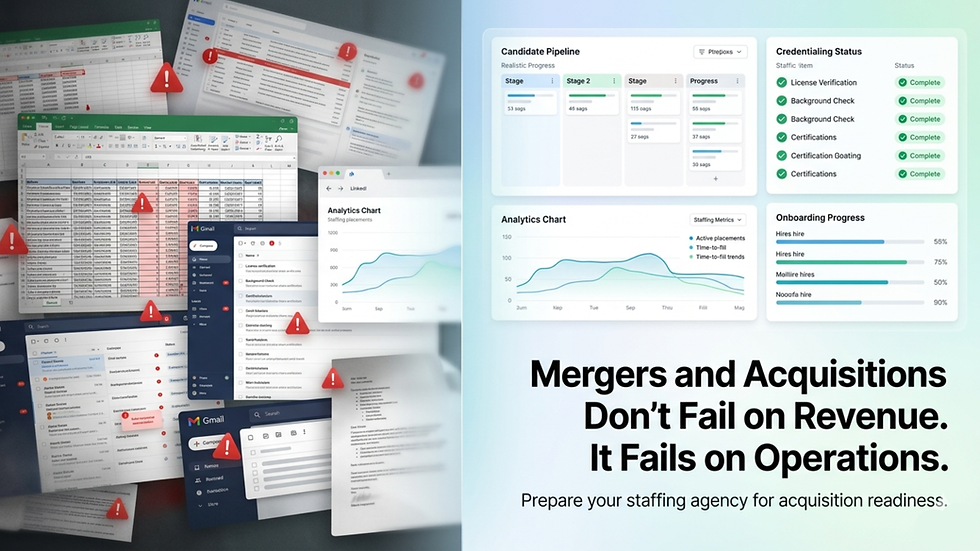
Most healthcare staffing mergers don’t collapse because the numbers don’t add up. On paper, things often look solid.
Where things actually fall apart is operations.
When a buyer starts digging in, messy workflows, scattered data, and unclear processes become obvious very quickly. If your agency still depends on spreadsheets, disconnected tools, or “this is how we’ve always done it,” it doesn’t signal flexibility; it signals risk.
Preparing for a merger isn’t something you start during due diligence. It’s something you build into your operations well before that. And in most cases, that means moving toward structured, trackable systems using healthcare staffing software.
Why do healthcare staffing agencies struggle during M&A due diligence?
From what we’ve seen in real-world implementations, financials are rarely the biggest concern. The real friction shows up in operational visibility, especially across recruiting, credentialing, and deployment workflows.
In one case, a mid-sized travel nurse staffing agency looked great from a growth standpoint. But once we looked closer, things started to unravel:
Credentialing data wasn’t centralized
Recruiter notes were scattered across different tools
Compliance tracking was mostly manual
No clear definition of “candidate readiness”
And this isn’t unusual.
At scale, things tend to break in predictable ways:
Credentialing is buried in email threads
Inconsistent onboarding steps
Recruiters and compliance teams working out of sync
No clear visibility into who is actually ready to deploy
What buyers are really evaluating:
They’re not just buying revenue. They’re buying how your business actually runs your systems, your workflows, and how reliably your team executes.
How should staffing agencies prepare operations before a merger?
If there’s one thing that consistently makes a difference, it’s standardization.
Agencies that prepare early usually have one thing in common: their workflows are documented, repeatable, and visible, often managed through a centralized staffing platform or a modern nurse staffing software.
Core workflows buyers evaluate:
Workflow Stage | What Buyers Evaluate |
Sourcing & Recruiting | Pipeline visibility, ATS structure |
Credentialing | Document tracking, expiry alerts |
Onboarding | Speed, consistency |
Deployment | Candidate readiness clarity |
Payroll & Billing | Accuracy, integrations |
Compliance | Audit readiness |
Common mistake:
Trying to fix everything once due diligence starts instead of preparing 3–6 months earlier.
How can staffing agencies reduce onboarding and credentialing delays?
This is one of those issues that looks small internally but becomes a major red flag externally.
Delays in onboarding, especially tied to credentialing, can quietly kill momentum.
One operations lead put it bluntly:
“We had candidates ready to go, but credentialing delays pushed deployment by weeks.”
That gap directly impacts:
Revenue timing
Client experience
Fill rates
Where things usually go wrong:
Manual document collection
No real-time tracking
Constant back-and-forth between teams
Missing or expired credentials
Where software helps:
A system like healthcare staffing software brings everything into one place:
Centralized credential tracking
Automated document collection
Real-time readiness visibility
Proactive compliance alerts
Pro tip:
Speed doesn’t come from working harder; it comes from removing friction between teams.
What does a “clean” staffing database look like during acquisition?
A large database might look impressive, but buyers don’t care about size.
They care about usability.
A strong database, usually managed through an integrated ATS inside a healthcare staffing platform, includes:
Structured skill tagging
Location and availability filters
Credential status visibility
Work history and compliance records
Consolidated recruiter notes
Common issues at scale:
Duplicate profiles
Outdated credentials
No segmentation
No visibility into active vs inactive candidates
Key takeaway:
Your database should function like a deployment engine, not just a resume storage system.
How do you prove operational efficiency to a potential buyer?
Buyers want measurable performance, not assumptions.
Key metrics that matter:
Time-to-fill
Time-to-deploy
Credentialing turnaround time
Fill rate
Clinician retention rate
Client repeat business
Where tools play a role:
Platforms like healthcare staffing software help generate:
Operational dashboards
Recruiter performance insights
Compliance reports
Deployment timelines
Important:
A tool alone won’t fix broken processes; it only makes them more visible.
How can staffing agencies prepare for smooth post-merger integration?
Integration is where many deals slow down.
Buyers prefer agencies that won’t create friction post-acquisition, especially those already operating on integrated systems like healthcare staffing operations platforms.
What makes integration smoother:
Documented workflows
Standardized compliance processes
Centralized systems
Clear reporting structures
What creates friction:
Legacy tools that don’t integrate
Manual payroll processes
Inconsistent onboarding
Lack of audit trails
Is healthcare staffing software necessary for M&A readiness?
Not always, but in most modern staffing environments, it becomes essential.
A platform like healthcare staffing software becomes critical when:
Managing multiple clients and facilities
Handling high candidate volume
Operating in compliance-heavy environments
What should staffing agencies fix first before preparing for a merger?
Start with the biggest operational bottlenecks:
Credentialing and compliance tracking
Onboarding workflow standardization
Candidate database cleanup
Recruiter → compliance → operations handoffs
Reporting visibility
If these are fragmented, even the best nurse staffing software won’t fully solve the problem.
Conclusion: Start Preparing Before You Need To
By the time you’re in merger discussions, it’s already too late to fix foundational issues.
Whether you implement healthcare staffing software or improve your internal systems, the goal is the same:
👉 Make your operations easy to understand, easy to trust, and easy to scale.


