
Nurse Workforce Management Software Guide

Updated: May 1
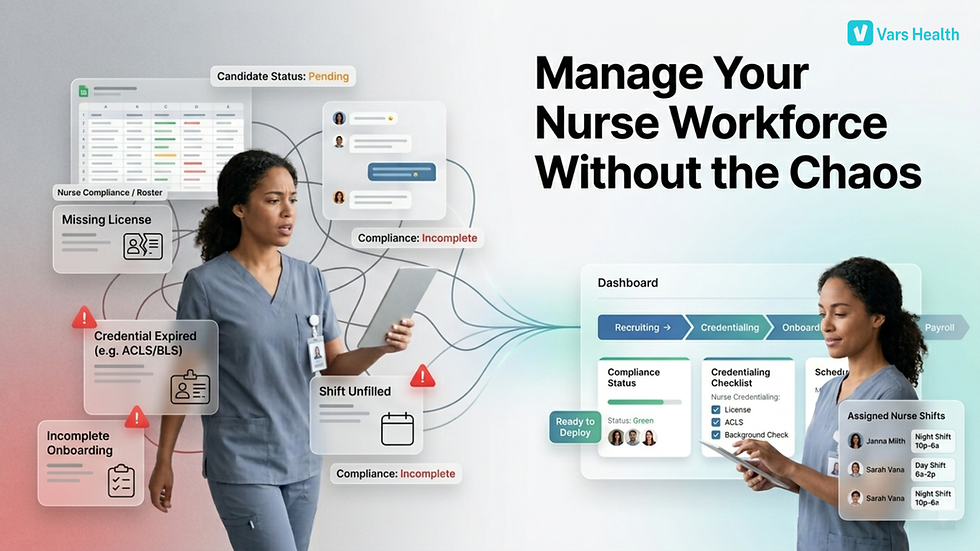
If you’re evaluating nurse workforce management software, the real question isn’t “what features does it have?” It’s how it connects with a complete healthcare staffing software platform.
For most healthcare staffing agencies, the biggest breakdowns don’t happen in sourcing; they happen between recruiting, credentialing, onboarding, and deployment. That’s exactly where workforce management software becomes operationally critical.
How does nurse workforce management software actually work inside a staffing agency?
At a high level, nurse workforce management software connects your entire operational workflow into one system, similar to a unified workforce management platform for healthcare staffing agencies.
In real implementations, this is what it replaces:
Recruiter spreadsheets
Credentialing checklists in emails
Separate compliance tracking tools
Manual scheduling coordination
Disconnected payroll and billing systems
What the workflow looks like in practice
Stage | Without Software | With Workforce Management Software |
Sourcing | Multiple tools | Centralized candidate pipeline |
Recruiting | Manual tracking | Structured ATS workflow |
Credentialing | Email + Excel | Automated checklist tracking |
Onboarding | Delays, missing docs | Guided onboarding workflows |
Scheduling | Calls & WhatsApp | Real-time shift assignment |
Payroll & Billing | Manual reconciliation | Integrated time + billing data |
Compliance | Reactive tracking | Proactive alerts & visibility |
Key takeaway for operations leaders:
The value isn’t just automation, it’s workflow continuity across teams.
Why do healthcare staffing agencies struggle to manage nurse workforce at scale?
When we worked with a mid-size travel nurse staffing agency, their biggest issue wasn’t hiring; it was getting nurses deployment-ready on time.
Here’s what typically breaks:
🔴 What usually breaks at scale
Credentialing delays due to missing documents
No visibility into candidate readiness
Recruiters and compliance teams working in silos
Last-minute scheduling gaps
Payroll errors from mismatched timesheets
🔴 Common operational mistake
Trying to fix these problems by adding more tools instead of fixing the workflow

What is the role of nurse staffing management software in solving these problems?
Nurse staffing management software acts as the operational backbone of your agency, not just a scheduling tool.
It helps unify:
Candidate tracking (ATS)
Credentialing workflows
Compliance monitoring
Onboarding processes
Workforce scheduling
Payroll and billing coordination
Where software actually helps (and where it doesn’t)
Software helps with:
Standardizing workflows
Automating repetitive steps
Improving visibility across teams
Reducing manual errors
But software alone won’t fix:
Poor internal processes
Lack of ownership between teams
Undefined workflows
Pro tip for staffing agencies:
Before implementing any system, map your current workflow end-to-end; that’s where most inefficiencies hide.
How does all-in-one nurse workforce management software work across teams?
Let’s break this down from a real operational perspective.
1. Recruiting → Structured pipeline instead of chaos
Recruiters move candidates through structured pipelines using an applicant tracking system for healthcare staffing:
Applied
Screened
Submitted
Interviewed
Offered
Instead of scattered updates, everything is tracked in one place.
2. Credentialing → Automated readiness tracking
One operations lead told us:
“We didn’t know who was actually ready to deploy until the last moment.”
With a centralized system:
Each candidate has a credentialing checklist managed through credential management workflows
Missing items are flagged automatically
Teams can track deployment readiness in real-time
3. Onboarding → Faster time-to-deploy
Onboarding becomes:
Document-driven
Checklist-based
Fully trackable
This directly impacts:
Time-to-fill
Time-to-deploy
4. Scheduling → Real-time workforce visibility
Instead of:
Calls
Emails
WhatsApp coordination
You get:
Shift assignment dashboards powered by real-time staffing scheduling software
Availability tracking
Conflict alerts
5. Payroll & Billing → Reduced reconciliation errors
This is one of the most underestimated problems.
Without integration:
Timesheets don’t match schedules
Payroll errors increase
Billing delays happen
With integrated workflows inside a unified healthcare staffing operations platform:
Time tracking flows into payroll
Billing becomes more accurate
6. Compliance → Proactive instead of reactive
Compliance teams can:
Track license expirations using compliance and workforce management systems
Monitor document validity
Get alerts before issues arise
Key takeaway for operations leaders:
Compliance is not a separate function; it must be embedded into the workflow.
Where does Vars Health fit into this workflow?
In real-world implementations, agencies don’t need another disconnected tool; they need a complete all-in-one solution for nurse workforce management that connects all moving parts.
This is where Vars Health is used as an operational layer within a complete healthcare staffing software solution for agencies across:
Recruiting (ATS workflow)
Credentialing & onboarding tracking
Compliance management
Scheduling & deployment visibility
Payroll and billing coordination
Example scenario
When an agency is scaling and handling high-volume workflows like per diem staffing operations:
Recruiters submit candidates
Compliance teams validate credentials
Operations track readiness
Scheduling assigns shifts
Payroll processes hours
With fragmented tools → delays, and errors
With Vars Health → one continuous workflow
Is workforce scheduling software enough, or do agencies need full workforce management?
Many agencies start with workforce scheduling tools like nurse scheduling apps for hospitals but quickly hit limitations.
Difference in practical terms
Scheduling Software | Workforce Management Software |
Focused on shifts | Covers end-to-end operations |
Reactive | Proactive workflow tracking |
Limited visibility | Full operational visibility |
No compliance tracking | Built-in compliance workflows |
Key takeaway:
Scheduling solves one problem. Workforce management solves the entire operational chain.
How should agencies approach implementing nurse workforce management software?
This is where most agencies get it wrong.
Step-by-step approach
Map your current workflow using structured healthcare staffing process documentation
Identify bottlenecks
Prioritize high-impact areas
Standardize processes before automation
Then implement software like Vars Health
🚨 Common mistake during implementation
Trying to automate a broken process, this only scales the problem faster
What should agency owners and operations managers look for in nurse workforce management software?
Focus on operational outcomes, not just features.
Must-have capabilities
End-to-end workflow visibility
Credentialing and compliance tracking
Real-time scheduling
Integrated payroll & billing
Reporting and analytics
These are typically covered in real-world healthcare staffing software case studies.
FAQ – Nurse Workforce Management Software
How long does it take to implement nurse workforce management software?
Typically 2–6 weeks, depending on workflow complexity and data migration.
Can small staffing agencies benefit from workforce management software?
Yes, especially if they want to:
Scale operations
Reduce manual work
Improve placement speed
What features matter most for compliance tracking?
Automated alerts
Credential expiration tracking
Centralized document management
Is nurse staffing management software the same as ATS?
No. An ATS handles recruiting, while workforce management covers:
Recruiting
Credentialing
Scheduling
Payroll
Compliance
Does software reduce time-to-deploy?
Yes, but only when combined with clear processes and defined ownership across teams.
Final takeaway for staffing leaders
If your agency is growing, the challenge isn’t just hiring more nurses; it’s moving them through your system efficiently and accurately.
The fastest way to improve operations isn’t adding more tools, it’s:
👉 Understanding your workflow gaps first
👉 Then, implementing a system that connects everything end-to-end
That’s where nurse workforce management software becomes less of a tool and more like a fully connected end-to-end staffing operations system.


