
Best Healthcare Scheduling Software in 2026

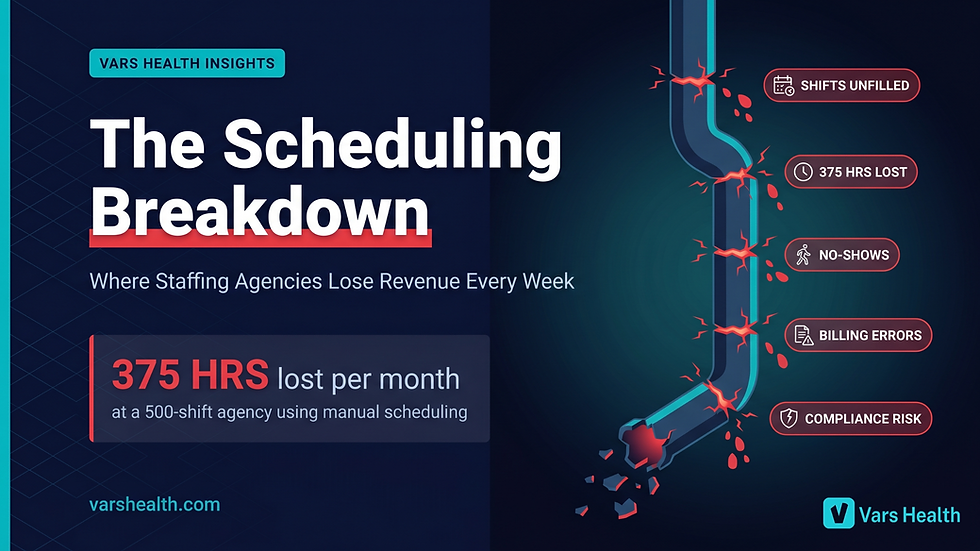
If you run a healthcare staffing agency and you’re still filling shifts through group texts, spreadsheets, and phone calls, you already know the problem. Shifts go unfilled. Coordinators burn out chasing confirmations. Clinicians get frustrated and stop picking up calls. The scheduling layer is where most per diem and travel staffing operations quietly lose revenue every single week.
This guide breaks down what to actually look for in healthcare scheduling software in 2026, how the top platforms compare, and where Vars Health fits if you’re running a staffing agency that needs to move faster at scale.
Why Do Healthcare Staffing Agencies Still Struggle With Scheduling in 2026?
The short answer: most agencies grew their scheduling process on tools that were never designed for clinical workforce management.
A spreadsheet works when you have 20 clinicians across 3 facilities. It stops working the moment you hit 200 clinicians, multi-state deployments, and facilities demanding same-day confirmation, and why Excel fails at scale becomes clear fast.
Here’s what typically breaks when agencies try to scale without dedicated scheduling software:
Shift visibility gaps — coordinators don’t know in real time who is available, credentialed, and geographically close enough to fill an urgent shift
Communication delays — chasing confirmations by phone or SMS adds 30–60 minutes per shift on average
No-shows and last-minute cancellations — without automated reminders and mobile self-service, no-show rates climb
Payroll errors — manual timesheet collection from multiple facilities creates billing discrepancies
Compliance blind spots — expired credentials don’t surface until after a clinician is already scheduled

What usually breaks at scale: The handoff between scheduling and payroll. Agencies running disconnected tools end up re-entering the same time data three or four times. That’s where billing errors and revenue leakage happen.
What Features Actually Matter in Healthcare Scheduling Software for Staffing Agencies?
Not all scheduling software is built for staffing agencies. Many tools on the market are designed for internal hospital workforce management, they assume one employer, one facility, one payroll system. Staffing agencies operate differently. You have a floating workforce deployed across dozens of client facilities, with different bill rates, credential requirements, and shift rules at each location.
Here’s what the scheduling module of your platform actually needs to handle:
Feature | Why It Matters for Agencies |
Real-time shift publishing | Coordinators post shifts, and clinicians see them instantly on mobile |
Automated clinician matching | System surfaces available, credentialed, nearby staff automatically |
Mobile self-service for clinicians | Staff pick up, decline, or drop shifts without calling the office |
Geo-fenced clock-in/clock-out | Accurate time records tied to the facility location eliminate timesheet disputes |
Multi-rate management | Different bill and pay rates per discipline, facility, and shift type |
Payroll and invoicing integration | Approved hours flow directly to billing and invoicing, with no manual re-entry |
Clients view, approve, and rate placements without calling your team | |
Credential-linked scheduling | The system only surfaces clinicians whose credential status is active and verified |
Pro tip for staffing agencies: Before evaluating any platform, map your current scheduling workflow step by step from shift request to confirmed clinician to payroll export. If a software vendor can’t show you exactly where their tool handles each of those steps, that’s your answer.
How Does Vars Health’s Healthcare Scheduling Software Work for Per Diem and Travel Agencies?
Vars Health built its scheduling module specifically for staffing agencies, not for internal hospital HR teams. That distinction matters operationally.
When a client facility sends a shift request, here’s how the workflow runs inside Vars Health:
Shift creation — coordinators build shifts using pre-filled templates with drag-and-drop scheduling. Shift details, including worker premiums, pay adjustments, and facility-specific requirements, are all configurable.
Automated clinician matching — the platform’s job engine scans your active workforce and surfaces available staff based on availability, distance, discipline, and credential status. Eligible clinicians get push notifications on the mobile app instantly.
Self-service acceptance — clinicians open the white-label mobile app, review the shift, and accept it. No phone call required. If a clinician drops a shift, the system re-notifies the next eligible candidate automatically.
Real-time dashboard visibility — operations leads see shift fill status across all facilities in one view. Daily clock-in and clock-out alerts confirm that deployed clinicians have actually checked in at the location, with geo-fenced time tracking tied to the facility address.
Payroll and invoice generation — approved hours flow directly into Vars Health’s payroll and invoice generation module. One-click invoice generation reduces billing cycle time significantly.
Common operational mistake: Agencies that implement scheduling software without connecting it to payroll end up solving only half the problem. The time savings on the front end disappear when coordinators still have to manually reconcile timesheets on the back end.
How Does Healthcare Scheduling Software Reduce Clinician Burnout and Turnover?
This question comes up often with agency owners who’ve been losing good clinicians to competitors with better self-service tools.
The burnout connection to scheduling is direct, and how smarter scheduling reduces nurse burnout is well-documented. When clinicians don’t have visibility into available shifts, have to call in to confirm availability, or receive last-minute schedule changes without notice, trust in the agency erodes quickly.
Vars Health’s mobile-first approach addresses this at the clinician level:
Clinicians manage their own availability, credentials, and shift preferences directly in the app
Real-time notifications for new shift opportunities mean faster decisions and fewer missed offers
Self-service shift acceptance and drop functionality give clinicians autonomy over their schedule
Transparent pay details on each shift reduce back-and-forth with coordinators
Key takeaway for operations leaders: Clinician retention is partly a scheduling experience problem. If your staff can’t see their schedule on their phone, pick up a shift, or manage their own availability through the mobile app without calling someone, they will eventually find an agency that lets them do all three.
Agencies that want to go deeper on this should read common nurse staffing scheduling pitfalls it covers the operational mistakes that cause clinician attrition.
How Does Healthcare Scheduling Software Compare Across Agency Types?
Different agency types have different scheduling complexities. Here’s a practical breakdown:
Agency Type | Core Scheduling Challenge | What to Prioritize |
Per diem | High-volume, same-day shift filling | Mobile self-service, automated matching, fast fill rate. See the per diem staffing operations guide. |
Travel nursing | Longer assignments, multi-state compliance | Credential-linked scheduling workflows that surface compliance gaps before deployment. |
Allied health | Multiple disciplines, varied certification requirements | Discipline-specific credential checks, rate management |
Locum tenens | Physician licensing, privileging, facility credentialing | Locum tenens staffing software built for that complexity |
Home health / hospice | Field-based workers, visit scheduling | Explore how home health staffing software handles visit-level workforce management |
Nurse staffing | Multi-state credentialing and compliance tracking | Nurse staffing software built for deployment workflows |
Vars Health’s healthcare scheduling software is purpose-built for per diem, travel, and allied health staffing agencies. The platform’s mobile app, automated matching engine, and credential-linked scheduling make it particularly practical for agencies running high-volume per diem operations where fill speed and compliance accuracy are both critical.
Is Healthcare Scheduling Software Worth the Investment for Mid-Size Agencies?
The ROI question is fair, and the answer depends on what your current operational cost actually is.
Consider a mid-size per diem agency filling 500 shifts per month. If coordinators spend an average of 45 minutes per shift on manual scheduling tasks, posting, confirming, chasing, re-notifying, that’s 375 hours of coordinator time per month. At loaded labor cost, that’s a significant operational expense that automation can reduce substantially.
Beyond labor cost, there’s a revenue impact. Every unfilled shift is a direct revenue loss. How healthcare staffing software maximizes fill rates explains exactly where that leakage happens. If manual scheduling processes result in even 5–10% of shifts going unfilled due to slow matching or communication delays, the financial case for purpose-built software becomes straightforward.
What to fix first vs. later: Start with the scheduling and time-tracking integration, which gives you the fastest measurable return. Layer in the client portal and payroll integration in phase two. Don’t try to overhaul everything at once.
Don’t try to overhaul everything at once common mistakes in healthcare staffing digital transformation are worth reviewing before you start.
That said, software alone doesn’t fix a broken process. If your credential management is disorganized and clinicians are frequently not deployment-ready, no scheduling tool will solve that problem. Vars Health addresses this by connecting scheduling with credential status, but agencies still need to own the credentialing process upstream.
Agencies managing multiple facility partners may also benefit from understanding how VMS automation integrates with scheduling to streamline multi-client operations.
You can also review the healthcare staffing software comparison page to see how platforms differ on key operational features.
Frequently Asked Questions
How long does it take to implement healthcare scheduling software?
Implementation timelines vary by platform and agency size. A focused per diem scheduling rollout can be operational within 2–4 weeks. Full platform implementation, including payroll, invoicing, and credential integration, typically takes 6–10 weeks, depending on data migration complexity and staff training.
What is the difference between healthcare scheduling software built for hospitals versus staffing agencies?
Hospital scheduling tools manage internal staff under one employer. Staffing agency scheduling tools need to handle a floating workforce deployed across multiple facilities, multiple bill rates, multiple credential requirements, and multiple payroll structures. See how all-in-one staffing agency software compares to single-function tools.
Can small healthcare staffing agencies benefit from scheduling software?
Yes, particularly if you’re running per diem operations. The fill-rate improvement and coordinator time savings scale to smaller operations. Platforms like Vars Health are designed to support agencies at different growth stages without requiring large IT teams to manage.
Does healthcare scheduling software integrate with existing payroll systems?
Most modern platforms support payroll integration. Vars Health connects scheduling, geo-fenced time tracking, and payroll in a single workflow, with data export capabilities to payroll systems. The key question to ask any vendor is whether the integration is native or requires a third-party connector.
How does credential-linked scheduling actually work in practice?
In Vars Health, a clinician’s credential status is tied to their profile. When a shift is published, the automated matching engine only surfaces clinicians whose active credential management status meets the facility’s requirements. If a credential expires, the system removes that clinician from eligible candidates until the credential is renewed, preventing non-compliant deployments before they happen.
What metrics should I track to know if scheduling software is working?
Focus on: shift fill rate, time-to-fill (from shift posted to confirmed clinician), no-show rate, coordinator hours per filled shift, and billing cycle time. Improvement in these five metrics indicates your scheduling operation is actually running more efficiently, not just differently.
Final Takeaway
Healthcare scheduling is one of those operational areas that looks manageable until it isn’t. Agencies that build on spreadsheets and manual coordination hit a wall when volume increases, and that wall usually appears as missed fills, coordinator burnout, and clinician attrition happening all at once.
The most practical next step: Before you evaluate any software, spend one hour mapping your current shift lifecycle from request to payroll export. Write down every manual step, every tool switch, and every point where a coordinator has to chase someone. That map will tell you exactly where software will have the most immediate impact, and it will make your software evaluation conversations far more productive.
If you’re running a per diem, travel, or allied health agency and want to see how Vars Health handles the scheduling workflow specifically, request a demo and walk through your actual operational scenario with the Vars Health team.

