
Best Nurse Scheduling Software for Efficient Workforce Management

Updated: Apr 30

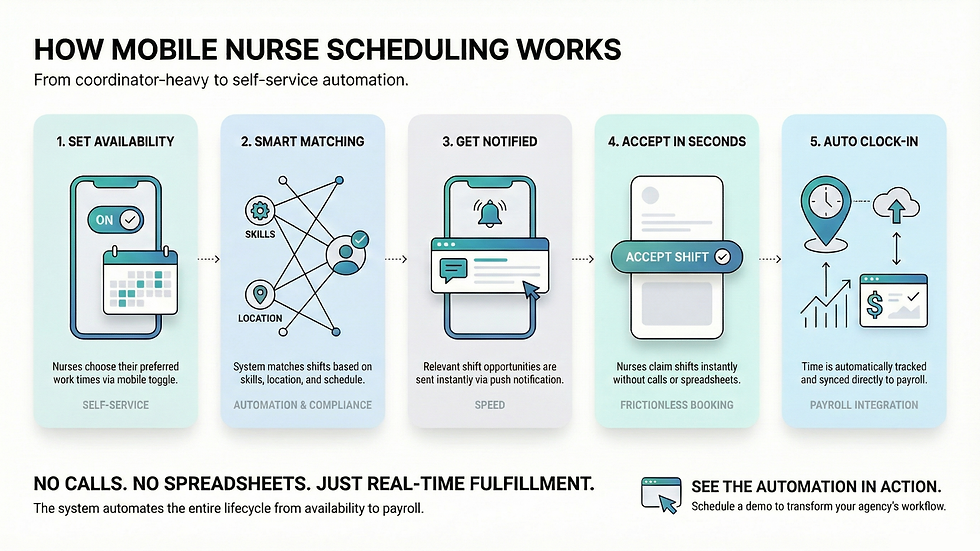
If you're running a healthcare staffing agency and still coordinating nurse shifts through spreadsheets, group texts, or manual email chains, you already know what this costs you. Missed confirmations, last-minute gaps, compliance blind spots, and coordinators buried in administrative tasks that should be automated. The right nurse scheduling software doesn't just organize your shifts, especially when evaluating the best staffing scheduling software for healthcare agencies. It accelerates fill rates, reduces coordinator workload, gives nurses mobile control over their schedules, and connects seamlessly to credentialing, payroll, and compliance tracking.
This guide walks through what actually separates functional scheduling tools from ones that hold your operations back and shows how Vars Health's healthcare scheduling platform addresses the real operational problems agencies face every day.
What Makes Nurse Scheduling So Difficult for Staffing Agencies Specifically?
Hospitals and clinics managing their own internal staff face scheduling complexity. But staffing agencies face a different problem entirely. You're coordinating a fluid, external workforce across multiple facilities, multiple shift types, and multiple compliance requirements, often with a lean operations team.
The most common pressure points agencies deal with:
Last-minute cancellations that require immediate replacement without a reliable bench visibility system
Credentialing status that isn't linked to scheduling, leading to compliance risk when an expired license gets placed
Coordinators manually call or text available nurses to fill open shifts
No single view of who is available, confirmed, deployed, or pending clock-in across facilities
Payroll errors caused by disconnected time tracking and scheduling data
Common operational mistake: Most agencies try to fix scheduling speed by hiring more coordinators instead of following best practices for shift scheduling in healthcare staffing. The actual problem is that coordinators are doing work the software should be doing: manual matching, manual confirmations, and manual compliance checks.
What Are the Key Benefits of Using Automated Nurse Scheduling Software?
Automation in scheduling isn't about replacing your team; it's about freeing them to do the work that actually requires judgment: managing relationships, handling exceptions, and growing the agency.
Here's what agencies consistently gain when they move from manual processes to purpose-built scheduling software:
Faster shift fill rates
Automated matching based on availability, credentials, discipline, and distance means open shifts get filled in minutes rather than hours. Coordinators stop manually scanning a roster and start reviewing confirmed fills.
Clinicians can view available shifts, accept assignments, set availability, and clock in and out all from their phone. This alone reduces the back-and-forth that eats coordinator time and irritates nurses who want control over their own schedule.
Real-time operational visibility
A live dashboard showing shift confirmations, clock-ins, active placements, and pending gaps means operations leaders aren't flying blind. When a coordinator calls out sick, another team member can pick up without needing a full briefing.
Compliance embedded into the workflow
When credential status is linked to scheduling eligibility, a nurse with an expiring license simply cannot be placed in shifts requiring that license. No manual check required. No compliance gap discovered after placement.
Reduced payroll and billing errors
Geo-fenced clock-ins tied directly to shift records eliminate the manual timesheet reconciliation that causes billing delays and payroll disputes, improving time tracking and scheduling for healthcare workforce management.
Key takeaway for operations leaders: The ROI on scheduling software is rarely just about speed. It shows up in compliance risk reduction, coordinator capacity, nurse retention, and billing accuracy areas that compound over time.
How to Choose Nurse Scheduling Software: What Features Actually Matter?
Not all scheduling platforms are built for healthcare staffing agencies. Many are built for hospitals managing internal staff, or for generic workforce management across industries. The requirements are fundamentally different.
When evaluating nurse scheduling software for your agency, prioritize the must-have staffing scheduling software features that actually impact operations:
Mobile-first design for clinicians, not just a mobile-responsive web page, but a true app that clinicians will actually use
Shift matching based on credentials, discipline, and geographic availability
Credential status is linked directly to scheduling eligibility
Geo-fenced time tracking that feeds automatically into payroll and billing
Client/facility portal for shift approvals and staff ratings
Multiple rate management across disciplines and facilities
Communication tools: SMS, push notification, and in-app messaging are built into the platform
Reporting and analytics on fill rates, time-to-fill, deployment readiness, and workforce costs
What usually breaks at scale: Agencies that grow past 200 active clinicians almost always hit the same wall: their scheduling tool can no longer keep up with the volume of coordination required. The tools that scale are the ones built specifically for healthcare staffing, not adapted from other industries.
How Does AI-Driven Scheduling Improve Staff Satisfaction and Fill Rates?
The phrase 'AI-powered' gets applied to almost everything in software today. In the context of nurse scheduling, what actually matters is whether the system can intelligently match the right clinician to the right shift faster than a coordinator could manually.
Vars Health's scheduling engine automates job matching based on:
Clinician availability and distance from the facility
Discipline and specialty requirements for the shift
Credential and certification status at the time of matching
Historical performance ratings from facilities
The practical impact is faster fill times and better fit placements, a pattern explored in depth in our guide to how scheduling software transforms workforce management. Clinicians get notified about shifts relevant to them, not every open shift in the system. Facilities get matched staff rather than a list of names to review.
From a satisfaction standpoint, the bigger driver is mobile self-service. When nurses can pick up shifts that fit their actual availability instead of waiting for a coordinator to call, engagement improves. The data from agencies using this model shows lower cancellation rates and higher shift acceptance rates because nurses feel like they have agency over their own schedule.
How Does Nurse Scheduling Software Support Compliance Management Without Extra Overhead?
Compliance is where manual scheduling breaks down at the worst possible time. A nurse placed at a facility with an expired BLS certification isn't just a credentialing oversight, it's a liability event. Read how agencies are avoiding staff scheduling pitfalls with nurse staffing software.
Most agencies track compliance in one of three ways: a spreadsheet updated manually, a credentialing system disconnected from scheduling, or a coordinator who checks each placement individually. None of these scales reliably.
Vars Health links credential management directly to scheduling eligibility. The moment a certification approaches expiration, the platform flags it. The moment it expires, that clinician is automatically ineligible for shifts requiring it. No coordinator step required.
For agency owners, this means:
Compliance gaps are prevented at the scheduling stage, not discovered after placement
Audit readiness improves because all credential records are centralized and timestamped
The coordinator's time spent on manual compliance checks can be redirected to relationship management and growth
Pro tip for staffing agencies: Compliance enforcement only works if your credentialing data is current. Before implementing scheduling software, do a one-time audit of your active clinicians' credential records. Agencies undergoing smarter scheduling to reduce nurse burnout report the same finding. Clean data going in means clean compliance outputs from day one.
How to Implement Nurse Scheduling Software in a Healthcare Staffing Agency
The biggest implementation mistakes aren't technical, they're operational. Agencies that struggle with adoption usually try to go live on everything at once. A detailed walkthrough is available in the guide to modernizing your agency's onboarding process.
A practical implementation sequence that works for most agencies:
Week 1–2: Migrate active clinician profiles, credential records, and facility data into the platform. Verify accuracy before enabling any scheduling functionality.
Week 2–3: Train coordinators on shift creation, the dashboard, and notification workflows. Run a parallel test week, create shifts in both the old system and the new one.
Week 3–4: Introduce the mobile app to clinicians. Provide a short walkthrough for clinicians who understand self-service adopt it quickly. Those who don't understand it default back to calling coordinators.
Week 4–6: Activate payroll and invoicing integration. Validate that geo-fenced clock-ins are mapping correctly to shift records before going fully live on billing.
Week 6–8: Enable client portal for facility contacts. Review your first reporting cycle fill rates, time-to-fill, and cancellation rates. Establish your baseline metrics.
Common operational mistake: Skipping the parallel testing week is the most common reason implementation fails. Two weeks of running both systems feels slow, but it catches data migration errors before they affect live placements.
Why Vars Health Is Built Differently Than Generic Nurse Scheduling Platforms
There are scheduling tools built for restaurants, retail, and generic shift work. There are internal hospital scheduling tools built for employed staff. And there is a much smaller category of platforms built specifically for healthcare staffing agencies managing an external, mobile workforce.
Vars Health sits in that third category. Here's what differentiates it operationally:
Feature | Spreadsheets | Generic HR Tools | Vars Health |
Nurse shift scheduling | Manual | Limited | ✓ Purpose-built |
Mobile self-service | None | Partial | ✓ Full app |
Credential tracking | None | None | ✓ Built-in |
Geo-fenced time clock | None | Rare | ✓ Included |
Payroll & invoicing link | Manual | Separate tool | ✓ Integrated |
Client portal | None | None | ✓ Included |
Per diem & travel support | None | No | ✓ Yes |
White-label mobile app | N/A | N/A | ✓ Agency-branded |
VMS automation | N/A | N/A | ✓ Included |
The white-label mobile app advantage
Most scheduling platforms give your nurses a generic app branded for the software vendor. Vars Health provides an agency-branded, white-label mobile app for your name, your branding, and your clinicians. For agencies focused on building workforce loyalty, this distinction matters. Clinicians associate the experience with your agency, not a third-party tool.
End-to-end in one platform
Vars Health connects the full operational chain: applicant tracking, onboarding, credential management, scheduling, time clock, payroll, invoicing, and client portal. Most agencies currently use 3 to 5 separate tools for these functions. Consolidation reduces integration errors, eliminates duplicate data entry, and gives operations leaders one dashboard instead of five.
VMS automation for multi-facility agencies
Agencies distributing open shifts across multiple sub-vendors or partner agencies can use Vars Health's built-in VMS automation without purchasing a separate VMS platform. This is operationally significant for agencies scaling into multi-facility contracts.
Key takeaway for operations leaders: The question is not whether to invest in scheduling software. The question is whether the tool you choose was designed for how a staffing agency actually operates or whether you'll spend months adapting a generic tool to fit your workflows.
Is Nurse Scheduling Software Worth It for Small and Mid-Size Staffing Agencies?
The assumption that scheduling software only pays off at a large scale is one of the most expensive beliefs a smaller agency owner can hold.
In reality, small agencies feel the manual coordination pain most acutely. A two-coordinator operation spending 60% of their time on shift confirmation calls is effectively burning that labor cost on work that software can do in seconds.
The math is straightforward. If scheduling software reduces coordinator administrative time by 30%, and your coordinators could use that time to manage more clinicians or facility relationships, the capacity gain is immediate. You're not adding headcount you're getting more output from the team you already have.
Vars Health's pricing structure is designed to accommodate agencies at different growth stages. You don't need to be managing 1,000 clinicians to benefit from automated shift matching and mobile self-service. You need enough open shifts that manual coordination is costing you time you could be spending on growth.
Frequently Asked Questions About Nurse Scheduling Software
How long does it take to implement healthcare staffing software?
Most agencies get core scheduling and shift management up and running within 2 to 4 weeks. Full onboarding, credential tracking, and payroll integrations typically take 4 to 8 weeks, depending on your existing workflows. Vars Health provides dedicated onboarding support to reduce implementation time.
What features actually matter for nurse shift scheduling?
The non-negotiables are: mobile self-service for clinicians, real-time shift notifications, geo-fenced time tracking, credential status visibility, and integration with payroll and billing. Everything else is secondary until those work reliably.
Can small staffing agencies benefit from scheduling software?
Yes. In fact, small agencies often see the fastest ROI because they're replacing entirely manual processes. You don't need to be filling 500 shifts a week to benefit from automated matching and mobile self-service.
Does Vars Health support per diem and travel nurse scheduling?
Yes. Vars Health is purpose-built for per diem agencies and also supports travel nurse and allied health placements. The platform handles multiple workforce types, multiple facilities, and multiple rate structures from a single dashboard.
How does Vars Health help reduce nurse burnout through scheduling?
By giving nurses control. The mobile self-service app lets clinicians view available shifts, choose what fits their schedule, and drop or swap when needed. Eliminating last-minute calls and confusion reduces the daily friction that drives burnout over time.
Is there a demo available for Vars Health's scheduling software?
Yes. You can book a live demo directly at varshealth.com to see the scheduling module, mobile app, credential management, and payroll integration in action, tailored to your agency type.
Does Vars Health integrate with existing payroll and billing systems?
Yes. Vars Health connects shift completion and geo-fenced time logs directly to payroll and invoicing workflows, reducing manual data entry and eliminating the most common billing errors.
How does nurse scheduling software support compliance management?
Vars Health links credential status directly to shift eligibility. If a nurse's license or certification is expiring, they cannot be scheduled for shifts that require it. This removes the manual compliance check that most coordinators are still doing by spreadsheet.
The Realistic Next Step for Your Agency
Scheduling is the operational heartbeat of a healthcare staffing agency. Every shift filled efficiently is revenue recognized and a clinician retained. Every missed confirmation, compliance gap, or payroll error is a cost, direct or indirect, that compounds over time. The right nurse scheduling software doesn't eliminate the judgment and relationships that make your agency successful. It removes the friction that slows those things down.
If your team is still manually coordinating shifts, chasing timesheets, or running credential checks before every placement, the most valuable thing you can do this week is map your current workflow from shift creation to payroll processing and identify where the hours are actually going. That exercise alone tends to make the decision straightforward.
Vars Health offers a live demo specifically for staffing agency owners structured around your workflow, not a generic product walkthrough. You can also review the full nurse staffing software buyer's guide before your call.


